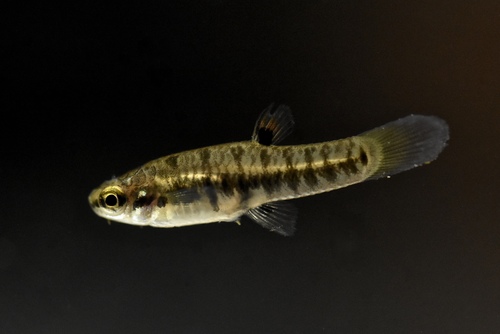
Least Killifish
Heterandria formosa
Meet North America's smallest fish, a tiny livebearer that thrives in the hidden jungles of backyard ponds and southern wetlands. Despite its name, it's not a killifish at all, but a resilient relative of the guppy with a unique way of raising its young.
Quick Identification
Size
Smallest fish in North America; males reach 0.8 inches (20 mm) and females reach 1.4 inches (36 mm).
Colors
Olive-tan body with a dark horizontal stripe and 7-9 faint vertical bars; black spots at the base of the dorsal and anal fins.
Key Features
- Tiny, slender body less than 1.5 inches long
- Dark horizontal stripe from snout to tail
- Distinctive black spot on the dorsal fin
- Live-bearing fish with females larger than males
When You’ll See Them
Geographic range
Where Does the Least Killifish Live?
The Least Killifish is native to the coastal plains of the southeastern United States. Its primary range stretches from the Cape Fear River drainage in North Carolina down through the entirety of the Florida peninsula and westward across the Gulf Coast into Louisiana. While they are lowland specialists, they have been introduced to various warm-water pockets outside this range due to their popularity in the aquarium hobby and accidental transport with aquatic plants.
Basemap © OpenStreetMap contributors
Behavior
The Least Killifish is a peaceful, social species that lives in loose groups within the safety of dense aquatic vegetation. Despite its name, it is actually a member of the livebearer family (Poeciliidae), meaning it gives birth to live young rather than laying eggs. They are unique for a process called superfetation, where females carry multiple broods of embryos at different developmental stages, allowing them to give birth to a few fry every few days during the breeding season.
Because of their incredibly small size, they are highly cautious and spend most of their lives darting between the stems of aquatic plants to avoid predators like sunfish and dragonfly larvae. In a backyard pond setting, they are non-aggressive and provide excellent mosquito control by eating larvae in shallow areas where larger fish cannot reach. They are rarely bothered by humans but will quickly hide if a shadow passes over the water.
EverydayEarth exclusive
Camera Tips
To capture the Least Killifish on camera, you must go underwater. These fish are far too small to be seen clearly from the surface, especially given their preference for hiding among plants. Place a waterproof action camera or a specialized underwater trail camera in the shallowest margins of your pond, no deeper than 6 to 12 inches. Use a macro lens attachment or ensure your camera is set to a close-focus mode, as the most interesting behavior happens within a few inches of the lens.
Position the camera lens to face a patch of fine-leafed aquatic plants like Hornwort, Anacharis, or Java Moss. These plants act as a natural stage where the fish feel secure enough to graze. Lighting is critical for such tiny subjects; try to position the camera so that mid-morning or early afternoon sun penetrates the water at a slight angle. If the area is heavily shaded, an auxiliary waterproof LED light can help highlight the iridescent scales and the dark spots on their fins that would otherwise be lost in the murky water.
You can encourage them to gather in front of the lens by gently disturbing the nearby substrate to kick up organic matter or by placing a very small amount of crushed fish flakes near the plants. Because they are social, once one fish finds the food, others will quickly follow. Set your camera to record high-frame-rate video (60fps or higher) if possible, as their movements are very quick and darting; slow-motion playback often reveals fascinating social interactions and feeding behaviors that the naked eye misses.
Similar Species
Species that look similar or are commonly confused with Least Killifish.
Western Mosquitofish
Larger than the Least Killifish, lacks the dark lateral stripe, and has a more uniform grey-silver coloration.
Sailfin Molly
Significantly larger with a much taller dorsal fin (in males) and a more robust, deep-bodied shape.
Eastern Mosquitofish
Grows larger (up to 2.5 inches) and lacks the distinctive black spots on the dorsal and anal fins.
Frequently Asked Questions
Record Least Killifish at your habitat
Connect a camera to start building your own species record — AI identifies every visitor automatically.