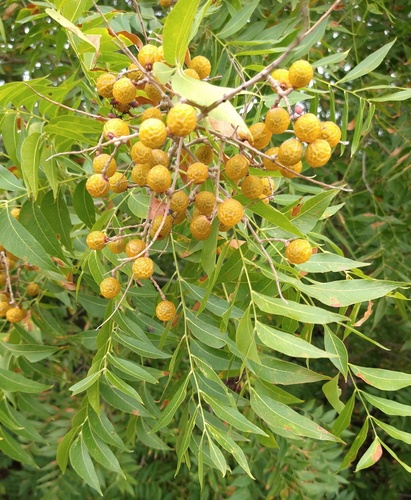
Western Soapberry
Sapindus drummondii
A hardy survivor of the American West, the Western Soapberry provides golden autumn beauty and a unique winter feast for backyard birds.
Quick Identification
Size
Medium-sized tree reaching 20–50 feet (6–15 meters) in height with a trunk diameter of 1–2 feet (30–60 cm).
Colors
Glossy dark green foliage turning golden yellow in fall; creamy-white flower clusters; translucent amber-orange berries that eventually turn black.
Key Features
- Pinnately compound leaves usually lacking a terminal leaflet
- Translucent amber berries that persist through winter
- Gray-brown bark that develops rough, scaly plates with age
- Small, creamy-white flowers in pyramid-shaped clusters
When You’ll See Them
Geographic range
Where Does the Western Soapberry Live?
Western Soapberry is native to the North American continent, specifically across the southern and central United States and northern Mexico. Its core range extends from Arizona eastward to Louisiana and as far north as Kansas and Missouri, often thriving in the heat of the Desert Southwest and the Great Plains. While not widely introduced abroad, it is a staple of arid-region conservation planting within its native North American borders.
Basemap © OpenStreetMap contributors
Behavior
The Western Soapberry is a resilient, deciduous tree known for its slow-to-moderate growth and long-lived nature. While it appears as a standard shade tree for much of the year, it undergoes a dramatic transformation in late spring when it produces large, panicle-like clusters of white blossoms. These flowers are a magnet for pollinators, particularly the rare Soapberry Hairstreak butterfly, which relies on this tree as its primary host.
As autumn approaches, the tree produces its most distinctive feature: clusters of grape-sized fruits. These berries are unique for their high saponin content, which creates a natural lather when crushed in water—a trait historically used by indigenous peoples for soap and laundry. In the landscape, the tree is highly drought-tolerant and wind-resistant, often forming small thickets in the wild through root suckering, though it typically grows as a single-trunk specimen in suburban backyards.
EverydayEarth exclusive
Camera Tips
To capture the best activity on a Western Soapberry, focus your camera on the mid-canopy during the late spring flowering season. This is when the tree becomes a hub for insect activity. Use a high-speed shutter setting to capture the rapid movement of the Soapberry Hairstreak butterfly and various native bees. Position the camera on a nearby structure or a tall tripod to get level with the flower panicles, as most of the action happens toward the outer edges of the branches.
During the winter months, the Western Soapberry becomes a vital food source for birds, even though the berries are toxic to humans and livestock. Cedar Waxwings and Robins are frequently seen foraging on the translucent fruits when other food sources are scarce. Aim your camera at the heavy fruit clusters against a clear blue sky or after a light dusting of snow for the most striking visual contrast. Since birds move quickly, a PIR (passive infrared) sensor with a fast trigger speed is essential.
If you are interested in the tree's growth and seasonal transition, set up a long-term time-lapse. Position the camera at least 15–20 feet away to capture the full crown. The most dramatic transition occurs in late October when the leaves turn a brilliant, uniform gold. Ensure your camera is securely mounted to a permanent post to prevent shifting over the months, and use a wide-angle lens to capture the tree's entire silhouette against the changing sky.
Similar Species
Species that look similar or are commonly confused with Western Soapberry.
Frequently Asked Questions
Record Western Soapberry at your habitat
Connect a camera to start building your own species record — AI identifies every visitor automatically.