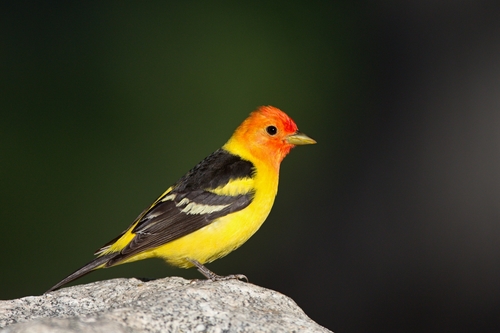
Western Tanager
Piranga ludoviciana
A splash of tropical color in the Western woods, the Western Tanager is one of North America's most stunning migratory birds. With its flame-colored head and brilliant yellow plumage, catching a glimpse of this 'canopy jewel' is a highlight for any backyard birder.
Quick Identification
Size
Length: 6.3–7.5 in (16–19 cm), Wingspan: 11.5 in (29 cm), Weight: 0.8–1.3 oz (24–36 g)
Colors
Males feature a brilliant orange-red head, bright yellow body, and coal-black wings and tail. Females and immatures are olive-yellow with grayish wings.
Key Features
- Brilliant orange-red head on breeding males
- Two distinct wing bars (upper yellow, lower white)
- Black back and tail contrasting with yellow body
- Thick, pale-colored bill with a slight hook
When You’ll See Them
Behavior
The Western Tanager is often described as a 'forest jewel,' though its preference for the high-canopy can make it surprisingly difficult to spot with the naked eye. These birds are methodical movers, hopping through branches rather than darting, as they search for insects or berries. While they are members of the cardinal family, their song is a raspy, 'sore-throat' version of an American Robin's melody.
During the breeding season, they are primarily solitary or found in pairs, maintaining territories in coniferous or mixed forests. In the backyard, they are less bold than chickadees but can become regular visitors if you provide the right habitat. They are known for a behavior called 'hawking,' where they fly out from a perch to snatch a flying insect mid-air before returning to the same spot.
EverydayEarth exclusive
Camera Tips
To successfully capture the Western Tanager on your EverydayEarth camera, you must think vertically. These birds spend the majority of their time in the upper third of the forest canopy. If you have a multi-story home, mounting a camera on a second-story deck or high on a tree trunk facing a branch 10-15 feet off the ground will significantly increase your success rate compared to ground-level setups. Look for 'corridor' branches that lead from dense cover to open space.
The absolute best lure for a Western Tanager isn't food, but moving water. Unlike many backyard birds, they are particularly drawn to the sound and visual shimmer of a drip. Using a birdbath with a 'dripper' or a small solar-powered fountain will act like a magnet for them, especially during the dry summer months. Position your camera about 3-5 feet from the water source at a slightly downward angle to capture the brilliant contrast of the male's red head against the water. This 'top-down' angle also helps identify the species' unique wing bars.
If you are using food to attract them, skip the standard birdseed mixes which they largely ignore. Western Tanagers are fruit and insect specialists. During late spring and summer, try placing a platform feeder with halved oranges, dried mealworms, or fresh berries like blueberries and raspberries. Set your camera to 'Burst Mode' or high-frame-rate video (60fps), as their visits to feeders are often quick 'hit-and-run' maneuvers compared to the more sedentary feeding style of finches.
Lighting is crucial for this species to avoid 'blowout' on the bright yellow feathers. To truly capture the 'glow' of their plumage, position your camera with the sun at the camera's back (facing North or East for morning shots). This prevents silhouetting and ensures the AI-powered color correction can accurately highlight the male’s flame-colored head. During peak migration in May and August, increase your camera's PIR sensitivity to 'High' to ensure you don't miss these fast-moving travelers as they pass through your yard.
Similar Species
Species that look similar or are commonly confused with Western Tanager.
Scarlet Tanager
Found mostly in the East, the male has a solid red body and lacks the Western Tanager's yellow wing bars and yellow body.
Summer Tanager
The male is entirely rose-red without any black on the wings or back.
Bullock's Oriole
Often confused due to orange and black colors, but the oriole has a thinner, more pointed beak and a distinct black throat patch.
Frequently Asked Questions
Record Western Tanager at your habitat
Connect a camera to start building your own species record — AI identifies every visitor automatically.