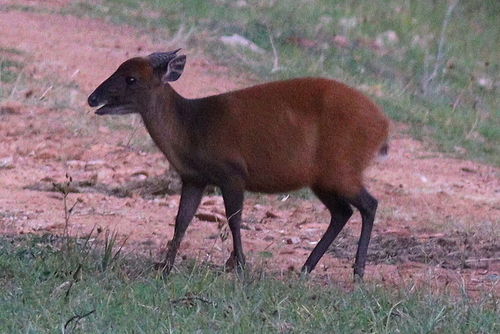
Weyns's Duiker
Cephalophorus weynsi
The Weyns's Duiker is the elusive 'forest diver' of the African tropics, known for its vibrant reddish coat and secretive lifestyle. A master of the undergrowth, this charming antelope is a prized find for any trail camera enthusiast.
Quick Identification
Size
Shoulder height 17-22 in (43-56 cm); weight 35-44 lbs (16-20 kg)
Colors
Rich reddish-brown (rufous) body; slightly darker dorsal stripe; pale throat and underbelly; dark tail with white fringe
Key Features
- Arched back with slender, delicate legs
- Short, straight horns (3-4 inches) present in both sexes
- Large, visible scent glands below the eyes
- Uniformly rufous coat with a subtle dark line along the spine
When You’ll See Them
Behavior
The Weyns's Duiker is a shy, secretive antelope primarily found in the dense rainforests of Central and East Africa. Like other forest duikers, its name comes from the Afrikaans word for 'diver,' referring to its habit of diving into thick brush at the slightest sign of danger. They are largely solitary animals, though they are occasionally seen in pairs during mating or when a mother is raising a calf. They are highly territorial, using the large scent glands under their eyes to mark branches and trunks along their preferred trails.
Interestingly, Weyns's Duikers have developed a commensal relationship with arboreal primates. They are often found lingering beneath troops of monkeys or flocks of birds, waiting for fruit, seeds, or flowers to be dropped from the canopy. While they are generally peaceful, they are extremely alert; their large ears are constantly twitching to catch the snap of a twig or the rustle of a predator like a leopard or a golden cat.
EverydayEarth exclusive
Camera Tips
Capturing the Weyns's Duiker requires patience and precise camera placement due to their height and shy nature. To get the best results, mount your camera quite low to the ground—approximately 12 to 18 inches (30-45 cm) high. This 'eye-level' perspective for a duiker provides a much more intimate view and makes it easier to distinguish them from similar-looking species by clearly showing the facial markings and the shape of the horns.
Focus your efforts on 'duiker runs'—well-trodden, narrow paths through the undergrowth. These animals are creatures of habit and will use the same trails daily to navigate between sleeping spots and feeding grounds. If you can locate a fruiting tree, especially a Ficus (fig) tree, this is the gold mine for duiker activity. Position your camera to overlook the area where fruit is falling, as multiple duikers may visit this 'buffet' throughout the day.
Because the forest floor is often dimly lit even during the day, use a camera with a high-speed trigger (0.3 seconds or faster) and a high-quality sensor to avoid motion blur. If your camera allows, set it to take a 3-shot burst; the first shot might just be a blur of rufous fur as they 'dive' away, but the subsequent shots often capture them pausing to look back. Avoid using high-intensity white flashes which will spook them and likely keep them away from that trail for days; a 'no-glow' infrared flash is much more effective for this sensitive species.
While they aren't attracted to traditional backyard birdseed, in a controlled research or forest-edge setting, mineral licks or salt blocks can sometimes act as a lure. However, the best 'lure' is natural food. If you are on a property that borders their habitat, clearing a small patch of dense leaf litter to reveal the soil, or simply leaving fallen fruit undisturbed, will naturally encourage them to pause in front of your lens.
Similar Species
Species that look similar or are commonly confused with Weyns's Duiker.
Frequently Asked Questions
Record Weyns's Duiker at your habitat
Connect a camera to start building your own species record — AI identifies every visitor automatically.