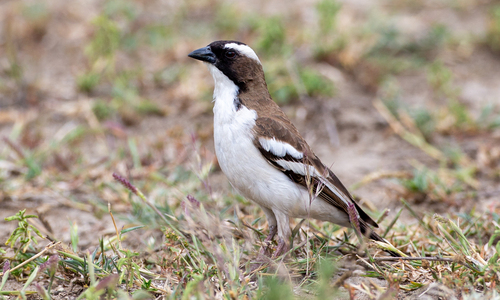
White-browed Sparrow-Weaver
Plocepasser mahali
With their striking white eyebrows and cheerful communal songs, White-browed Sparrow-Weavers are the bustling socialites of the African savanna. These industrious birds are famous for their messy 'haystack' nests and their fascinating family-oriented lifestyle.
Quick Identification
Size
Length: 17–19 cm (6.7–7.5 in); Weight: 35–55 g (1.2–1.9 oz)
Colors
Mottled brown upperparts with a bold white supercilium (eyebrow) and a distinctive white rump; underparts are mostly white. Sexes look alike, but breeding males have black bills while females and juveniles have horn-colored bills.
Key Features
- Broad white stripe above the eye
- Large white rump visible during flight
- Untidy, football-shaped nests made of dry grass
- Social groups of 2-11 individuals
- Loud, liquid, whistling duet song
When You’ll See Them
Sightings on EverydayEarth
Jul 11, 2026
A White-browed Sparrow-Weaver is active on the dry ground near the edge of the pan. It hops briefly while foraging for seeds or insects before pausing in the dappled shade of a small shrub.
Jul 7, 2026
A single White-browed Sparrow-Weaver is seen hopping along the dry ground to the left of the watering hole. It appears to be foraging for food in the sparse vegetation before moving out of sight behind a small bush.
Jul 7, 2026
A White-browed Sparrow-weaver is foraging near the water's edge. The bird is seen hopping across the dry, sandy ground on the left side of the pan, occasionally stopping to probe the substrate for food.
Jul 4, 2026
A White-browed Sparrow-Weaver lands on the left bank of the watering hole. It hops along the muddy edge, briefly pausing to drink and scan its surroundings in the bright morning light.
Jul 3, 2026
A White-browed Sparrow-Weaver perches on a small branch at the edge of the water hole. It is active, turning its head and appearing to call, while the morning sun reflects off the still water of the pan.
May 18, 2026
A group of White-browed Sparrow-Weavers are perched together on the outer branches of a bush. The birds are active, scanning their surroundings and adjusting their footing as the camera zooms in to provide a detailed view of the flock.
Geographic range
Where Does the White-browed Sparrow-Weaver Live?
Native to the African continent, the White-browed Sparrow-Weaver thrives across a wide band of central and southern Africa. Its range begins in the dry scrublands of Ethiopia and Somalia, extending southward through Kenya and Tanzania, and expanding across the vast bushveld of Zimbabwe, Botswana, Namibia, and northern South Africa. This species is a dedicated resident, rarely wandering far from its established colony and nesting trees.
Basemap © OpenStreetMap contributors
Behavior
The White-browed Sparrow-Weaver is one of the most social and vocal birds of the African savanna. They live in permanent, highly structured family groups consisting of a dominant breeding pair and several non-breeding "helpers." These helpers play a crucial role in the colony, assisting with the defense of the territory and the feeding of the breeding pair's chicks. You will often hear them before you see them, as the group engages in a loud, synchronized whistling song that serves to warn off intruders and strengthen social bonds.
These birds are industrious builders, but their architectural style is decidedly messy. They construct large, hollow tubes of dry grass that resemble clumps of hay stuck in trees. Unlike most birds that only build for the breeding season, Sparrow-Weavers use these nests year-round for roosting. They are bold and curious birds, often becoming quite tame around safari lodges, campsites, and suburban gardens where they scavenge for food scraps and splash enthusiastically in birdbaths.
EverydayEarth exclusive
Camera Tips
To capture the best footage of White-browed Sparrow-Weavers, focus on their ground-level activity. These birds spend a significant portion of their day hopping across the soil in search of insects. Place your AI-powered camera on a low tripod or mount it about 12 inches off the ground, aiming at a patch of bare earth or short grass, especially near the base of an acacia tree where their messy nests are visible. Because they are social and travel in groups, a wide-angle lens is often better than a tight zoom to capture the interaction between family members.
Water is a massive draw for this species. Setting up your camera near a shallow birdbath or a dripping irrigation line will almost guarantee a visit. They are vigorous bathers, so use a fast shutter speed or high-frame-rate video setting to freeze the water droplets as they shake their wings. If you are trying to lure them into a specific frame for a portrait, a small handful of birdseed or mealworms scattered on a flat rock works wonders. They are bold and will quickly habituate to the presence of a camera, so don't be afraid to place the device relatively close to their favorite foraging spots.
Keep an eye on the lighting, as their bright white eyebrows and rumps can easily overexpose in the harsh African sun. The best "golden hour" shots occur shortly after sunrise or just before sunset when the light is softer. If your camera allows for activity zones, set them around the entrance of their nests; they often perch at the threshold for a few seconds before diving inside, providing the perfect opportunity for a clear, still shot of their facial markings.
Similar Species
Species that look similar or are commonly confused with White-browed Sparrow-Weaver.
Frequently Asked Questions
Record White-browed Sparrow-Weaver at your habitat
Connect a camera to start building your own species record — AI identifies every visitor automatically.