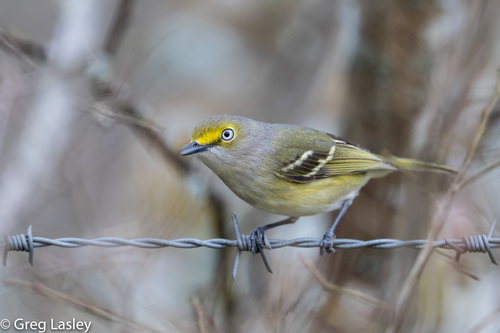
White-eyed Vireo
Vireo griseus
A master of the thicket, the White-eyed Vireo is a punchy songbird known for its striking white eyes and bold, 'spectacled' face. This secretive inhabitant of the scrub brings a loud personality to the hidden corners of your backyard.
Quick Identification
Size
Length: 11-13 cm (4.3-5.1 in), Wingspan: 17 cm (6.7 in), Weight: 10-14 g (0.35-0.49 oz)
Colors
Olive-green upperparts, white underparts with yellow flanks, two white wing bars, and yellow 'spectacles' around the eyes; adults have white irises.
Key Features
- Distinctive white iris in adults
- Yellow 'spectacles' around the eyes
- Two white wing bars on olive wings
- Small, thick-billed songbird with a white throat
When You’ll See Them
Geographic range
Where Does the White-eyed Vireo Live?
The White-eyed Vireo is native to the North American continent, primarily occupying the Eastern and Southern United States. Its breeding range stretches from the Atlantic coast westward to the Great Plains, while populations in Florida, the Gulf Coast, and parts of Mexico remain as year-round residents. During the winter, many individuals migrate to warmer climates in Central America, the Caribbean islands, and coastal Mexico.
Basemap © OpenStreetMap contributors
Behavior
The White-eyed Vireo is a secretive but highly vocal inhabitant of dense shrubbery. Unlike many other vireos that stay high in the canopy, this species prefers the 'skulker' lifestyle, moving through thickets and overgrown fields with quick, hopping movements. They are known for their explosive, snappy songs that often sound like they are saying 'chick-per-a-weeo-chick,' which they use to vigorously defend their territories.
While they are shy around humans and rarely venture into open spaces, they are incredibly curious. If you remain still near a thicket, they may pop out to investigate your presence. They are solitary birds during the breeding season but can sometimes be found in mixed-species foraging flocks during migration and winter months, searching for insects among the leaves.
EverydayEarth exclusive
Camera Tips
To capture the White-eyed Vireo on camera, you must focus on 'edge' habitats. These birds rarely cross open lawns, so place your camera 2 to 4 feet off the ground, facing the interior of a dense hedge or the edge of a wooded thicket. Low-angle shots are essential because they spend most of their time foraging in the mid-to-lower strata of vegetation.
The absolute best lure for this species is a moving water source. A birdbath with a solar bubbler or a dripping fountain placed near dense cover will entice them to step out of the shadows. Because they are fast-moving and exhibit 'nervous' twitching behaviors, set your camera to a high trigger speed and use a multi-shot burst mode to ensure you get a clear image of their signature white iris.
Seasonality plays a major role in camera placement. During late summer and fall, position your camera near native fruiting plants like American Beautyberry, Wax Myrtle, or Elderberry. The birds will frequent these bushes to fuel up for migration, offering excellent opportunities for close-up shots. Ensure your camera is positioned to catch the morning light, as this is when they are most active and vocal.
Similar Species
Species that look similar or are commonly confused with White-eyed Vireo.
Frequently Asked Questions
Record White-eyed Vireo at your habitat
Connect a camera to start building your own species record — AI identifies every visitor automatically.