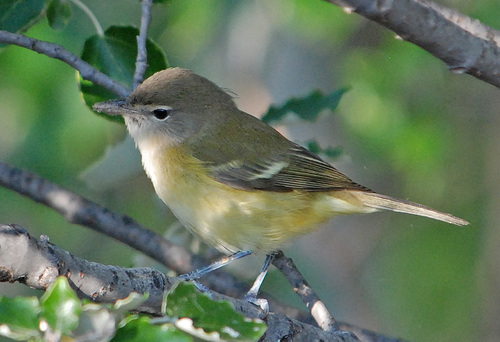
Bell's Vireo
Vireo bellii
The Bell's Vireo is a master of camouflage, blending perfectly into the dense thickets it calls home. Famous for its 'question-and-answer' song and energetic tail-flicks, this elusive songbird is a rewarding find for any backyard wildlife enthusiast.
Quick Identification
Size
Length: 11-13 cm (4.3-5.1 in); Wingspan: 17-19 cm (6.7-7.5 in); Weight: 7-10 g (0.25-0.35 oz)
Colors
Dull olive-gray to brownish-gray upperparts; creamy white or pale yellow underparts; faint white 'spectacles' and two subtle white wing bars.
Key Features
- Broken white eye-ring (spectacles)
- Two faint white wing bars (lower is more visible)
- Frequent, nervous tail-twitching
- Heavy-based bill with a tiny hook at the tip
When You’ll See Them
Geographic range
Where Does the Bell's Vireo Live?
Native to the North American continent, Bell's Vireo has a breeding range that stretches from the central United States through the Southwest and into California. These hardy songbirds migrate annually, traveling through Mexico to reach their wintering grounds in the tropical scrub and mangroves of Central America. While they are most concentrated in the Great Plains and the desert southwest, specific subspecies like the Least Bell's Vireo are found in very localized pockets of coastal and inland California.
Basemap © OpenStreetMap contributors
Behavior
Bell's Vireos are known among birders as the ultimate 'skulkers.' They rarely venture into the open, preferring the deep protection of dense, scrubby thickets where they forage with restless energy. They are extremely active birds, characterized by a frequent tail-wagging or flicking motion that can help a sharp-eyed observer spot them even when their drab plumage blends into the shadows. Their presence is most often announced by their unique song—a series of scolding, husky notes that sound like a conversation ending in both a question and an answer.
Unlike many other vireo species that stay high in the canopy, Bell's Vireos are ground-to-mid-story specialists. They are fiercely territorial during the breeding season, often engaging in 'singing duels' with neighboring males. While they are generally shy around humans, they are highly focused foragers and can be observed for long periods if you remain still near a known nesting thicket. They are also unfortunately common targets for brood parasitism by Brown-headed Cowbirds, which has impacted their population in many regions.
EverydayEarth exclusive
Camera Tips
Capturing a Bell's Vireo on camera requires a strategy focused on low-level density. Because these birds rarely fly high, mount your camera between 3 and 5 feet off the ground, aimed directly at an opening in a thicket or a dense shrub. If you have native willow, mesquite, or thick brambles in your yard, these are the primary 'highways' the birds will use. Avoid aiming the camera at the sky; instead, focus on the horizontal branches where they are likely to stop and glean insects.
A shallow water feature is your best tool for drawing this species out of the shadows. A dripping birdbath or a small ground-level fountain placed near the edge of dense cover is irresistible to Bell's Vireos. They are cautious bathers, so ensure the camera is set to a high-speed trigger or video mode to capture their quick 'dip-and-dash' bathing style. Using a camera with a macro or close-focus capability is essential, as these birds are small and their identifying marks—like the faint wing bars—can be lost on a standard wide-angle trail cam.
Since Bell's Vireos are incredibly fast and twitchy, set your camera to take a burst of 3-5 photos per trigger. This increases the chance of catching a frame where the bird isn't a blur of motion. Early morning is the best time for lighting and activity, as they are most vocal and active just after sunrise. If you are using a smart camera with AI, ensure it is trained on small songbirds, as their drab colors can sometimes cause them to be overlooked by motion sensors designed for larger mammals.
Similar Species
Species that look similar or are commonly confused with Bell's Vireo.
Warbling Vireo
Lacks wing bars and has a distinct pale eyebrow stripe rather than broken spectacles.
Hutton's Vireo
More olive-toned with a much thicker bill and a complete white eye-ring that is more prominent.
Ruby-crowned Kinglet
Smaller with a much thinner bill and a constant, frantic wing-flicking motion rather than tail-wagging.
Frequently Asked Questions
Record Bell's Vireo at your habitat
Connect a camera to start building your own species record — AI identifies every visitor automatically.