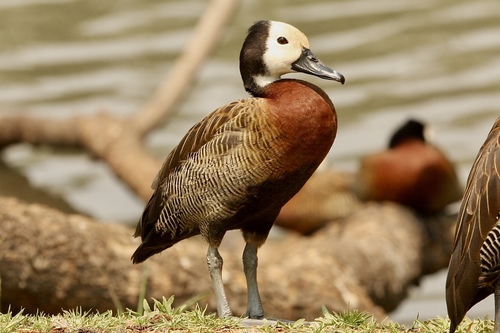
White-faced Whistling-Duck
Dendrocygna viduata
A social icon of the wetlands, the White-faced Whistling-Duck is instantly recognizable by its striking white mask and haunting three-note whistle. While other ducks sleep, this elegant 'whistler' comes to life under the cover of darkness.
Quick Identification
Size
Length: 38–48 cm (15–19 in); Wingspan: 86–94 cm (34–37 in); Weight: 500–820 g (1.1–1.8 lbs)
Colors
Distinctive white face and throat with a black crown and nape. Body features a rich chestnut breast, black belly, and finely barred black-and-white flanks. Males and females look identical.
Key Features
- Bright white 'mask' covering the face and throat
- Long, dark grey bill and legs
- Chestnut-colored breast
- Finely barred black-and-white pattern on the sides
- Erect, goose-like posture when standing
When You’ll See Them
Sightings on EverydayEarth
Jul 1, 2026
A group of White-faced Whistling-Ducks is gathered on the muddy shoreline of the waterhole. Several individuals are preening and resting, while one walks across the marshy bank to join the others. In the grassy middle ground to the left, an Egyptian Goose is foraging and moving slowly through the vegetation.
Jul 1, 2026
A flock of White-faced Whistling-Ducks is gathered in a shallow, muddy area of the waterhole. The ducks are mostly resting and preening themselves. In the background, a white wading bird, likely an egret, stands motionless among the marsh vegetation.
Jun 29, 2026
Under the warm glow of the afternoon sun, a large African elephant stands by the waterhole with its trunk raised toward its mouth. A group of White-faced Whistling Ducks is lined up along the water's edge in the foreground, remaining still while the larger mammal visits the bank.
Jun 28, 2026
A small group of White-faced Whistling-Ducks is gathered on the far bank of the waterhole, standing alert among the shoreline vegetation. In the foreground, a Red-knobbed Coot swims calmly across the surface near a dense patch of lily pads. The water is still, reflecting the surrounding landscape under bright daylight.
Jun 12, 2026
A herd of Plains Zebras is gathered at the water's edge, with several individuals drinking and others standing alert on the bank. In the foreground, a White-faced Whistling-Duck swims across the lily-covered surface of the waterhole.
Jun 4, 2026
A Common Hippopotamus rests quietly in the water near the left bank of the pan. A large flock of White-faced Whistling-Ducks is scattered across the water's surface, some swimming and others floating. In the foreground, a small bird perches briefly on a weathered tree stump, surveying the landscape before the video ends.
Behavior
These birds are exceptionally vocal, earning their name from a clear, three-note whistle ('sir-wi-wi') that they use to maintain contact with the flock. During the flight, the sound of a large group can be heard from a significant distance. They are generally approachable in areas where they are not hunted, and they have adapted well to human-modified landscapes like golf course ponds and agricultural reservoirs.
EverydayEarth exclusive
Camera Tips
Capturing the White-faced Whistling-Duck requires a camera with excellent low-light or infrared (IR) capabilities, as these birds are most active after sunset. Set your camera to a high-sensitivity motion trigger and consider using 'Hybrid Mode' if available, which captures a high-resolution still followed by a 15-20 second video clip. This is the best way to record their unique three-note whistle and social interactions like mutual preening, which are far more interesting to watch than a simple still image.
For the best perspective, place your camera very low to the ground—approximately 12 inches high—near the water's edge. Look for 'loafing spots' such as flat, muddy banks or sandbars where you see webbed tracks and droppings. Position the camera facing the bank rather than the open water to avoid false triggers from ripples and to ensure the infrared flash illuminates the birds' white facial masks clearly. If you are on private property, scattering a small amount of poultry grain or cracked corn in the shallow water (just 2-3 inches deep) can entice a flock to stay in front of your lens for an extended period.
Audio is a crucial component of the EverydayEarth experience with this species. If your camera has a microphone, ensure it is turned to the highest sensitivity. The whistling calls of this duck are iconic; capturing the sound of a flock arriving at your location in the dark adds a hauntingly beautiful layer to your footage. Because they are social, once one bird lands, many more usually follow, so set your 'PIR Delay' to the shortest possible interval to avoid missing the arrival of the full group.
During the breeding season, these ducks may nest in tall grass or even in tree cavities near water. If you discover a nesting site, do not move the camera too close, as human scent can attract predators. Instead, use a long-range PIR sensor or a telephoto lens setting if your camera supports it. In tropical regions, the best time to capture large numbers is the peak of the dry season when birds concentrate around the last remaining permanent water sources.
Similar Species
Species that look similar or are commonly confused with White-faced Whistling-Duck.
Frequently Asked Questions
Record White-faced Whistling-Duck at your habitat
Connect a camera to start building your own species record — AI identifies every visitor automatically.