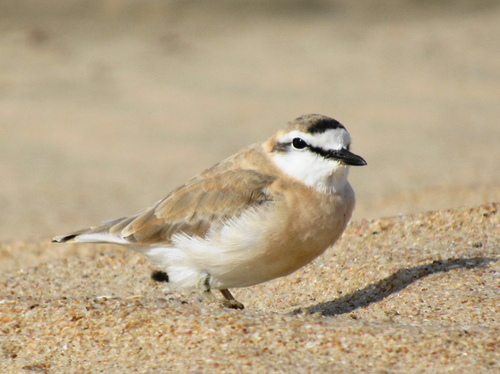
White-fronted Plover
Anarhynchus marginatus
The spirited sprinter of the shoreline, the White-fronted Plover is a master of camouflage and coastal survival. With its lightning-fast footwork and dedicated family life, this tiny bird is the true heart of the African beach.
Quick Identification
Size
Length: 16–18 cm (6.3–7.1 in); Wingspan: 35–40 cm (13.8–15.7 in); Weight: 35–55 g (1.2–1.9 oz)
Colors
Pale sandy-grey to light brown upperparts; pure white underparts and forehead; males feature a thin black line through the eye and a black bar on the fore-crown.
Key Features
- White forehead and prominent white collar
- Thin dark line running through eyes to the bill
- Pale, sandy-colored plumage that blends with beach dunes
- Rapid, darting running motion followed by sudden pauses
When You’ll See Them
Behavior
The White-fronted Plover is a high-energy coastal specialist known for its incredible speed on the sand. These birds spend much of their day patrolling the shoreline, using a 'run-stop-peck' foraging technique where they dart across the beach, pause to scan for movement, and then strike at tiny prey with precision. They are highly territorial birds that often stay with the same mate and defend the same stretch of beach for their entire lives, which can span up to 12 years.
Socially, they are usually seen in pairs or small family groups rather than large flocks. During the nesting season, they become masters of camouflage, laying eggs in shallow scrapes in the sand that are nearly impossible to spot. If a human or predator gets too close to their nest, they are famous for their 'broken-wing display,' where they feign an injury to lure the intruder away from their eggs or chicks. They are relatively tolerant of humans if given space, but they are easily disturbed by off-leash dogs on beaches.
EverydayEarth exclusive
Camera Tips
To capture great footage of these low-profile birds, you must get your camera down to their level. Avoid using standard tripods; instead, use a ground-mount or a sandbag to position your AI camera just 3-5 inches off the sand. An upward-tilted lens will capture the bird's white breast and facial markings much better than a top-down angle. Aim your camera toward the high-tide 'drift line'—the line of seaweed and debris left by the tide—as this is where their favorite insect prey congregates.
Patience and placement are more effective than bait. These birds are creatures of habit and will often use the same flat rock or piece of driftwood as a lookout point to scan for predators. If you can identify a piece of beach debris that shows signs of bird activity, such as small three-toed tracks or droppings, that is the perfect spot for your camera. Avoid using food lures, as this can attract gulls or crows that may raid the plovers' nearby nests; let the natural insect activity at the water's edge do the work for you.
Because the beach environment is highly reflective, your camera's sensor can easily become overwhelmed by the bright sand and white feathers of the plover. Set your camera to a slightly lower exposure if possible, or position it so the sun is behind the camera (front-lighting the bird). The 'golden hour'—the hour after sunrise or before sunset—provides the most flattering light, highlighting the subtle tan and grey textures of their wings while preventing the white belly from looking like a glowing blur in the frame.
If you are filming in a high-wind coastal area, ensure your camera housing is protected from salt spray and blowing sand, which can pit the lens over time. A small lens hood or even a DIY cardboard shield can keep the glass clear. Since these birds move in sudden, erratic bursts, a high-speed trigger or a video mode with a high frame rate (60fps) is ideal for capturing that classic, lightning-fast plover sprint without motion blur.
Similar Species
Species that look similar or are commonly confused with White-fronted Plover.
Kentish Plover
The Kentish Plover has darker legs and more prominent dark patches on the sides of the chest compared to the paler White-fronted Plover.
Kittlitz's Plover
Kittlitz's has a distinct yellowish or buff-colored breast and a black band that wraps around the back of the neck, whereas the White-fronted is stark white below.
Common Ringed Plover
Much larger with a bold, full black 'necklace' or chest band and bright orange legs, making it easy to distinguish from the daintier, dark-legged White-fronted.
Frequently Asked Questions
Record White-fronted Plover at your habitat
Connect a camera to start building your own species record — AI identifies every visitor automatically.