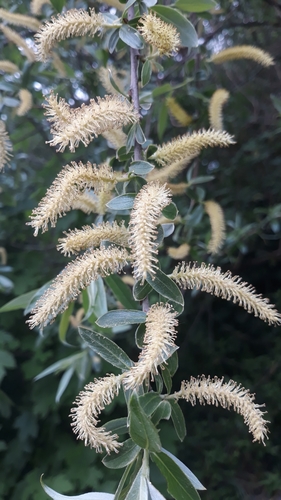
white willow
Salix alba
The shimmering sentinel of the riverbank, the White Willow is a vital haven for backyard biodiversity. Its silvery leaves and flexible branches offer beauty to the landscape and essential shelter to a wide array of visiting wildlife.
Quick Identification
Size
Height of 20-30 meters (65-100 feet); canopy spread of 10-20 meters (33-65 feet)
Colors
Leaves are bright green above and silvery-white underneath; bark is grey-brown with deep vertical fissures
Key Features
- Narrow, lance-shaped leaves with fine white silky hairs on the underside
- Deeply fissured, corky grey-brown bark on mature specimens
- Slender, flexible twigs that are typically yellowish-brown
- Produces upright yellow catkins in early spring
When You’ll See Them
Behavior
The White Willow is a fast-growing, deciduous tree known for its resilience and affinity for water. It acts as a pioneer species in damp environments, frequently colonizing riverbanks and marshlands where its extensive, aggressive root system works to stabilize shifting soil and prevent erosion. In the landscape, it is characterized by its shimmering appearance; when the wind catches the canopy, the pale undersides of the leaves are revealed, making the tree appear to turn silver or white.
Ecologically, the White Willow is a cornerstone species. It is among the first to provide nectar and pollen for bees in the spring through its catkins. Its dense foliage and tendency to develop hollows as it ages make it a premier habitat for nesting birds, bats, and hundreds of species of insects. While it is hardy, it is relatively short-lived compared to oaks, often reaching maturity and declining within 100 to 150 years.
EverydayEarth exclusive
Camera Tips
To capture the true beauty of a White Willow on an AI-powered camera, time-lapse is your most powerful tool. Set your camera to take a photo every hour during daylight for an entire season. This allows you to witness the 'green explosion' of spring, the shimmering silver effect of summer winds, and the golden-yellow transformation in autumn. Mount the camera at a distance of at least 20 feet on a tripod or a neighboring structure to ensure the entire crown of the tree fits within the frame.
If you are interested in the wildlife that calls the willow home, focus your camera on the lower 'forks' of the main trunk or any visible hollows. Many birds, including woodpeckers and owls, utilize the soft wood of the White Willow for nesting. Place the camera 5-6 feet high, angled slightly downward toward a large limb. Since willows are high-traffic areas for insects, you may also catch flycatchers and warblers darting in and out of the leaves to forage during the early morning hours.
For the best visual results, position your camera so the sun is behind it (facing north or east in the afternoon). This 'front-lighting' emphasizes the white, silky hairs on the leaves, which is the species' most diagnostic feature. If your camera has adjustable sensitivity, turn it down slightly on windy days; the willow’s flexible branches move easily, which can trigger hundreds of false-positive videos if the motion sensor is set too high.
Similar Species
Species that look similar or are commonly confused with white willow.
Weeping Willow
Features long, pendulous branches that sweep the ground, whereas White Willow grows more upright.
Crack Willow
Twigs are highly brittle and snap with a distinct 'crack' sound when bent, and leaves lack the dense white hairs of Salix alba.
Goat Willow
Has much broader, oval-shaped leaves and usually remains a large shrub or small tree rather than a tall timber tree.
Frequently Asked Questions
Record white willow at your habitat
Connect a camera to start building your own species record — AI identifies every visitor automatically.