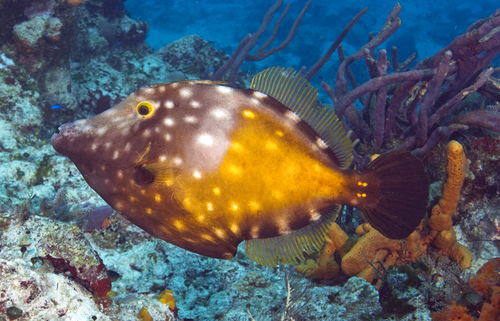
Whitespotted Filefish
Cantherhines macrocerus
A kaleidoscopic wonder of the Atlantic reefs, the whitespotted filefish is a shy master of disguise. Known for its sandpapery skin and ability to change color in a heartbeat, it is one of the Caribbean's most charismatic residents.
Quick Identification
Size
Typically 10-15 inches (25-38 cm) in length, though some individuals can reach up to 18 inches (45 cm).
Colors
Highly variable olive-brown, gray, or bright orange; covered in small white spots. Males often display large orange-red patches near the tail base.
Key Features
- Deeply compressed, diamond-shaped body
- Rough, sandpapery skin texture
- First dorsal spine can be locked in an upright position
- Two pairs of small, hooked spines on the tail base (males)
- Small mouth with prominent, nipping teeth
When You’ll See Them
Geographic range
Where Does the Whitespotted Filefish Live?
Native to the Western Atlantic Ocean, the whitespotted filefish is a common sight in the tropical waters of North and South America. Its core range extends from the Florida Keys and the Gulf of Mexico through the Bahamas and the entire Caribbean basin. It is also frequently found as far south as the northern coast of Brazil, making it a staple of the region's coral reef ecosystems.
Basemap © OpenStreetMap contributors
Behavior
The whitespotted filefish is a master of camouflage, famous for its ability to rapidly change its color and pattern to blend into the surrounding coral and sea fans. This is not just a defensive mechanism; it is also a way to communicate mood or social status. They are typically found in monogamous pairs, patrolling a specific territory on the reef. Unlike many fish that use their tails for speed, filefish move with a gentle, fluttering motion by undulating their dorsal and anal fins, which allows them to maneuver precisely through tight reef crevices.
While they are generally shy and will retreat into a hole when startled, they are quite curious about stationary objects. When they feel threatened, they engage a unique defense mechanism: they wedge themselves into a crevice and lock their large, thick first dorsal spine upright. This makes it almost impossible for a predator to dislodge them. During the day, they are focused grazers, meticulously picking at the reef surface for a variety of small organisms.
EverydayEarth exclusive
Camera Tips
To capture high-quality footage of a whitespotted filefish, you will need a waterproof action camera or an underwater housing. Because these fish are wary of movement, the best strategy is to use a weighted tripod or a 'gorillapod' to mount your camera on a sandy patch adjacent to a reef structure or a large sponge. Once the camera is set, move several meters away; the fish will often return to their favorite grazing spots within minutes once they perceive the environment is safe.
Lighting is crucial for this species because their colors are highly dependent on depth and light spectrum. At depths below 5 meters, red and orange colors disappear. To reveal the brilliant orange patches on a male whitespotted filefish, use an external video light or a red filter. This will prevent your footage from looking washed out and blue, and will highlight the intricate white spot patterns that give the fish its name.
Set your camera to a high frame rate, such as 60fps or 120fps. This allows you to slow down the footage in post-production, which is particularly effective for showcasing the delicate, undulating motion of their translucent dorsal and anal fins. Avoid using a zoom lens if possible; instead, position the camera close to a known 'cleaning station' or a patch of gorgonian fans where these fish frequently forage. The texture of their sandpapery skin is a fantastic detail to capture in a close-up macro shot.
Similar Species
Species that look similar or are commonly confused with Whitespotted Filefish.
Frequently Asked Questions
Record Whitespotted Filefish at your habitat
Connect a camera to start building your own species record — AI identifies every visitor automatically.