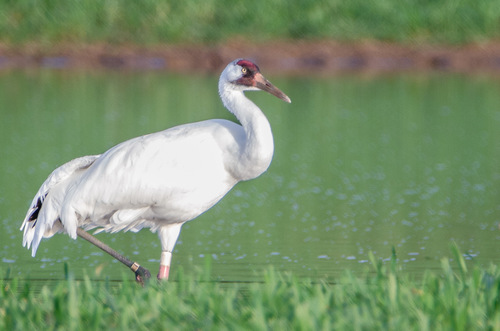
Whooping Crane
Grus americana
Standing as the tallest bird in North America, the Whooping Crane is a breathtaking symbol of wildlife conservation and persistence. With its snowy white feathers and haunting call, seeing one in the wild is a rare and unforgettable experience.
Quick Identification
Size
Height: 5 ft (1.5 m); Wingspan: 7-8 ft (2.1-2.4 m); Weight: 10-18 lbs (4.5-8.2 kg)
Colors
Brilliant white body with black primary wingtips (only visible in flight); adult head has a red crown and black facial markings
Key Features
- Tallest bird in North America, standing nearly five feet tall
- Pure white plumage with distinct black wingtips
- Bright red skin on the crown and black 'mustache' markings
- Long, dark legs that trail behind in flight
When You’ll See Them
Behavior
Whooping Cranes are majestic, social birds known for their complex courtship displays. These 'dances' involve leaping, wing-flapping, and head-bobbing, which help strengthen pair bonds and diffuse aggression. They are highly territorial during the nesting season but may form loose groups during migration or on their wintering grounds. Their famous 'whooping' call, produced through an exceptionally long windpipe coiled behind the breastbone, can carry for miles across open wetlands.
While they are wary of human presence, Whooping Cranes are increasingly seen in agricultural fields during migration, where they forage for waste grain. They are monogamous and typically mate for life, with both parents playing an active role in raising their young (colts). Their survival is a triumph of conservation, as they have rebounded from a population of just 21 birds in the 1940s to several hundred today through intensive recovery programs.
EverydayEarth exclusive
Camera Tips
Capturing a Whooping Crane on a trail camera requires a blend of patience and specific placement, as these birds are extremely wary and have an incredible field of vision. Because of their height, standard low-ground camera mounts will often only capture their legs. Aim to mount your camera 3 to 4 feet off the ground, slightly tilted upward, to ensure you get their distinctive red-crowned heads in the frame. If you are near a wetland or a harvested cornfield where they have been spotted, place the camera at the transition zone between the water's edge and the upland feeding area.
Since Whooping Cranes are endangered, it is illegal and unethical to approach them closely or disturb their nesting sites. Instead, use a high-quality camera with a sensitive PIR (passive infrared) sensor that can trigger from a distance. A camera with a fast shutter speed is essential if you hope to capture their 'dance' or the moment they take flight, as their wingspan can cause significant motion blur in lower-end models. Wide-angle lenses are preferable because of the bird's massive size; a narrow field of view might cut off the head or tail of the crane if it walks too close.
For the best results, focus on the golden hours—shortly after sunrise and just before sunset—when the light is soft and the cranes are most active in feeding. If your camera allows for burst mode, set it to take 3-5 photos per trigger. This increases the chances of capturing a clear shot of their black primary feathers or their elegant walking gait. During winter months in Texas or Louisiana, cameras near shallow, brackish ponds are most effective, while Midwestern users should target corn or soybean fields following the harvest.
Similar Species
Species that look similar or are commonly confused with Whooping Crane.
Sandhill Crane
Smaller and gray-bodied rather than white, with a more common and widespread population across North America.
Great Egret
Much smaller with an all-white body (no black wingtips) and a yellow bill; lacks the red crown of the Whooping Crane.
American White Pelican
Also white with black wingtips, but has very short legs, a massive orange pouch-bill, and a stockier body.
Frequently Asked Questions
Record Whooping Crane at your habitat
Connect a camera to start building your own species record — AI identifies every visitor automatically.