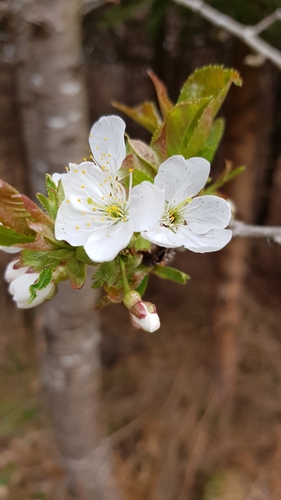
wild cherry
Prunus avium
A spectacular pioneer of the spring forest, the Wild Cherry provides a vital bridge between winter dormancy and summer abundance. Its snowy blossoms and rich, dark fruits make it a magnet for backyard biodiversity.
Quick Identification
Size
Height 15–32 m (50–105 ft); trunk diameter up to 1.5 m (5 ft)
Colors
White flowers, shiny reddish-brown bark, vibrant green leaves, bright red to dark purple fruit
Key Features
- Shiny reddish-brown bark with prominent horizontal lenticels
- Clusters of white 5-petaled flowers appearing in early spring
- Serrated oval leaves with two small red glands at the base of the leaf blade
- Bright red to deep purple-black fruit (cherries) measuring 1-2cm
When You’ll See Them
Behavior
Prunus avium is a fast-growing pioneer species that often serves as the cornerstone of a developing woodland. It is one of the first trees to announce the arrival of spring, exploding into a cloud of white blossoms before its leaves have fully emerged. This early flowering strategy ensures it captures the attention of the season's first pollinators, such as queen bumblebees and hoverflies, when other food sources are scarce.
In the landscape, the wild cherry is a social hub. It doesn't just sit still; it actively interacts with the local fauna through a complex cycle of giving and taking. By midsummer, the tree produces an abundance of sugar-rich fruit. While humans find some wild varieties bitter, birds and mammals find them irresistible. This relationship is a classic example of mutualism: the animals receive a high-energy meal, and in exchange, they disperse the cherry pits across the landscape, allowing the species to colonize new territories.
EverydayEarth exclusive
Camera Tips
To capture the best of the wild cherry, your camera strategy should change with the seasons. During the spring bloom (April-May), position your camera at a mid-level height, ideally 5-7 feet, focused on a dense cluster of blossoms. This is the best way to catch high-resolution photos of pollinators like solitary bees and early butterflies. Use a fast shutter speed to freeze the motion of wings against the white petals.
When the fruit ripens in June and July, the wild cherry becomes a hotspot for avian activity. Mount your camera on a nearby sturdy branch or a fence post with a clear view of the fruiting canopy. Aim for areas where the cherries are most abundant. Since birds like thrushes, waxwings, and starlings move quickly, a video trigger or a 'burst' photo mode is essential to capture the moment they pluck a cherry from the stem.
Don't overlook the ground beneath the tree. Wild cherries drop significant amounts of fruit, creating a natural bait station for nocturnal visitors. Lower your camera to about 12-18 inches off the ground and point it toward the base of the trunk. This setup is perfect for filming foxes, badgers, and deer that visit under the cover of darkness to forage on the fallen sweets. For the best night shots, ensure your camera's infrared flash is unobstructed by low-hanging leaves.
Similar Species
Species that look similar or are commonly confused with wild cherry.
Bird Cherry
Bird cherry has flowers that grow in long, hanging tassels (racemes) rather than the rounded clusters found on wild cherry.
Sour Cherry
Sour cherry is a smaller, more shrub-like tree with smaller leaves and fruit that is much more acidic to the taste.
Black Cherry
Native to North America, it has longer, narrower leaves and much smaller fruit that grows in long hanging clusters.
Frequently Asked Questions
Record wild cherry at your habitat
Connect a camera to start building your own species record — AI identifies every visitor automatically.