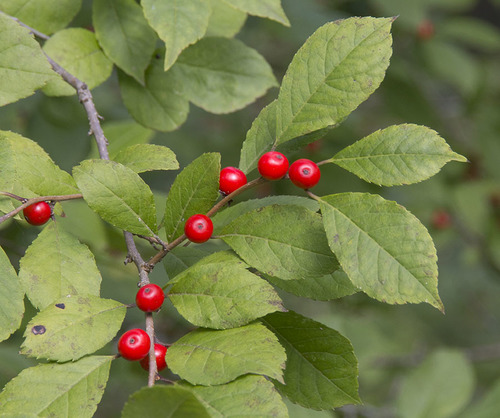
winterberry holly
Ilex verticillata
The crown jewel of the winter garden, winterberry holly provides a spectacular burst of red that serves as a vital survival station for backyard birds.
Quick Identification
Size
6–15 feet (1.8–4.6 meters) in height and spread
Colors
Dark green leaves in summer; bright scarlet-red berries on female plants; smooth light gray bark
Key Features
- Clusters of bright red berries that persist after leaves fall
- Deciduous habit with leaves turning yellow-bronze in autumn
- Multi-stemmed, rounded shrub growth
- Dioecious species requiring both male and female plants for fruit
When You’ll See Them
Behavior
Winterberry holly is a standout in the backyard landscape because of its unique deciduous nature. Unlike the classic evergreen hollies associated with winter, this species sheds its foliage in late autumn. This leaf drop serves a strategic purpose for wildlife watchers: it leaves behind thousands of densely packed, bright red berries that cling to the bare stems, creating a high-visibility feast for wintering birds.
As a 'slow and steady' grower, winterberry often forms thickets through suckering, providing essential cover and nesting sites for birds in the spring. It is a dioecious plant, meaning individuals are either male or female. To see the iconic red berries, a female plant must be pollinated by a male 'pollinizer' nearby. In the wild, it acts as a late-season pantry, with berries that are often ignored by birds in the fall but become highly palatable after several freeze-thaw cycles have softened them.
EverydayEarth exclusive
Camera Tips
When setting up a camera for winterberry holly, your target isn't just the plant itself, but the 'wildlife hub' it creates. Position your camera 4 to 6 feet away from the berry-heavy branches of a female plant. Instead of pointing the camera directly at the center of the shrub, aim it at an angle across the outer stems. This allows you to capture birds like Cedar Waxwings, Eastern Bluebirds, and American Robins as they land on the perimeter to pluck berries.
For the most dramatic shots, height is critical. Place your camera at eye level with the mid-section of the shrub (usually 3 to 5 feet high). If you are using a trail camera with a 'macro' or close-focus setting, use it here to capture the intricate details of the frost on the berries and the frantic feeding action. Use a fast trigger speed—under 0.5 seconds—because the birds visiting these berries move incredibly quickly, often hovering for a split second before grabbing a fruit.
Winterberry is most active during the first major cold snaps of the year. Set your camera to 'Burst Mode' or 'Photo + Video' during these periods. This is when the berries have finally softened enough for birds to eat. You will often capture dozens of birds at once in a feeding frenzy. If you are using video, ensure your microphone is active; the sound of dozens of wings and the 'clinking' of the berries is a hallmark of winterberry activity.
Consider your lighting carefully. The bright red berries can easily 'wash out' or overexpose in direct midday sun, especially against a snowy backdrop. Aim your camera facing North or South to avoid the direct glare of the low winter sun. A slightly overcast day actually provides the best color saturation for the berries and the birds. Finally, ensure your batteries are fresh or use a solar pack, as cold winter temperatures will drain standard trail camera batteries much faster than usual.
Similar Species
Species that look similar or are commonly confused with winterberry holly.
Frequently Asked Questions
Record winterberry holly at your habitat
Connect a camera to start building your own species record — AI identifies every visitor automatically.