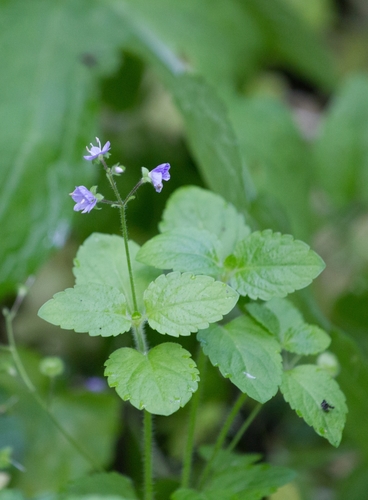
Wood Speedwell
Veronica montana
A delicate gem of the damp forest floor, Wood Speedwell charms with its pale lilac blooms and creeping green carpets. This shade-loving wildflower is a sign of a healthy, established ecosystem in your backyard or local woodland.
Quick Identification
Size
Stems 10-40 cm (4-16 inches) long; Flowers 6-10 mm (0.24-0.4 inches) wide
Colors
Pale lilac or light blue petals with prominent darker violet veins; hairy, mid-green foliage
Key Features
- Hairy stems that creep and root at nodes
- Pale lilac flowers with distinct dark purple veins
- Broadly heart-shaped, coarsely toothed leaves
- Preference for damp, shaded woodland habitats
When You’ll See Them
Behavior
Wood Speedwell is a quiet, creeping perennial that specializes in life on the forest floor. Unlike its sun-loving relatives, this species thrives in the dappled shade of deciduous woodlands, where it spreads horizontally through trailing stems. These stems have a unique habit of rooting into the damp soil as they grow, allowing the plant to form soft, green carpets over time. It is often considered an indicator of ancient or long-established woodland ecosystems.
The plant's behavior is most evident during its flowering season from mid-spring to early summer. Each individual bloom is a masterclass in delicate engineering, featuring dark veins that act as nectar guides for visiting insects. The flowers are highly responsive to environmental conditions, opening wide during bright, humid days and closing up during heavy rain to protect their delicate reproductive organs and pollen.
EverydayEarth exclusive
Camera Tips
To capture high-quality images of Wood Speedwell, you must get your camera down to its level. Since this is a low-growing creeper, place your AI camera or trail cam on a mini-tripod or a beanbag just 4 to 8 inches above the ground. Angle the lens slightly upward to capture the intricate purple veins on the pale lilac petals, which are the plant's most striking feature. In a backyard setting, look for the dampest, shadiest corner near a fence or under a deciduous tree for the best placement.
Lighting is your biggest challenge in the woodland environment. The pale petals of the Wood Speedwell can easily become overexposed or "blown out" in direct sunlight. The best time to record is on a bright but slightly overcast day, or during the morning hours when the light is soft and diffused. If your camera allows for manual exposure settings, underexpose slightly to preserve the detail in the delicate flower veins. Avoid using a direct flash, which can flatten the image and lose the fine texture of the hairy stems.
Because Wood Speedwell is a magnet for small pollinators, use a high-speed trigger setting or a "short-interval" photo mode. Small hoverflies and solitary bees are the primary visitors, and they move quickly. By setting the camera to take 3-5 shots in rapid succession when motion is detected at the flower head, you are much more likely to capture a stunning action shot of a pollinator in flight. For a unique perspective, try a time-lapse over a period of 12 hours (from 7 AM to 7 PM) to see how the flowers track the light and open fully as the temperature rises.
Similar Species
Species that look similar or are commonly confused with Wood Speedwell.
Frequently Asked Questions
Record Wood Speedwell at your habitat
Connect a camera to start building your own species record — AI identifies every visitor automatically.