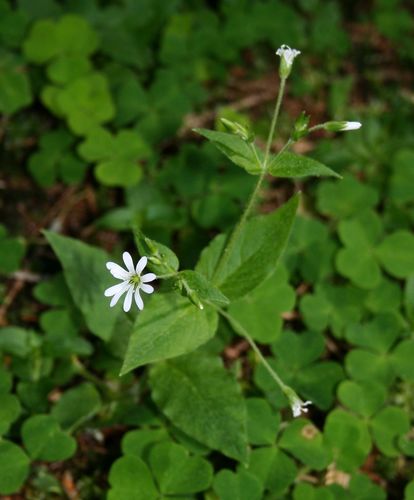
Wood Stitchwort
Stellaria nemorum
A luminous star of the shaded forest, Wood Stitchwort paints the woodland floor with delicate white blooms and heart-shaped leaves. This moisture-loving perennial is a sign of a healthy, ancient ecosystem and a favorite for early summer pollinators.
Quick Identification
Size
Grows 20-60 cm (8-24 inches) in height with flowers 12-18 mm (0.5-0.7 inches) in diameter.
Colors
Brilliant white petals with yellow-green centers; bright green foliage; stems may show a reddish tint at the base.
Key Features
- Five deeply split white petals that look like ten distinct petals
- Lower leaves are heart-shaped with distinct stalks
- Upper leaves are stalkless (sessile) and more oval
- Round stems featuring a single line of fine hairs along one side
When You’ll See Them
Behavior
Wood Stitchwort is a hardy herbaceous perennial that characterizes the lush, damp understory of ancient woodlands. It spreads primarily through stolons—horizontal runners that creep across the forest floor—allowing it to form expansive, star-studded mats of green and white. This growth strategy makes it highly effective at colonizing shaded areas where other plants might struggle with low light levels.
During the day, the flowers open wide to greet the sun and attract a variety of pollinators. While it doesn't 'move' in the traditional animal sense, it is highly reactive to its environment; its stems are brittle (giving it the name 'stitchwort,' as it was once believed to cure 'stitches' or pains in the side) and it will lean significantly toward any available light source. In the garden or backyard, it acts as a peaceful neighbor, providing essential ground cover for small invertebrates.
EverydayEarth exclusive
Camera Tips
When targeting Wood Stitchwort with your backyard camera, stability and macro-focus are your best friends. Because this plant sits low to the ground, use a flexible tripod or a 'ground spike' mount to get the lens level with the blooms. This perspective creates a much more immersive image than shooting from a standing height. If you are using an AI-powered camera, ensure the focus is locked on the center of a flower cluster rather than the background foliage.
To capture the 'wildlife' aspect of this wildflower, set your camera to a high-trigger sensitivity or use a time-lapse setting. Wood Stitchwort is a magnet for hoverflies, small bees, and even the occasional butterfly. By setting a time-lapse interval of one frame every 30 seconds during the peak morning hours, you can create a beautiful sequence of the flowers opening and the various 'micro-wildlife' that visits for nectar.
Lighting in the woods is notoriously tricky. Avoid using a harsh direct flash, which can 'blow out' the delicate white of the petals. Instead, position your camera so that the subject is lit by filtered, dappled sunlight. If you are shooting in a particularly dark corner of the yard, a small, battery-powered LED panel set to a low, warm brightness can help bring out the texture of the heart-shaped leaves and the fine hairs on the stems. Early June is the best time to set up your gear, as the plant is at its most vibrant before the heat of late summer begins to fade the blooms.
Similar Species
Species that look similar or are commonly confused with Wood Stitchwort.
Greater Stitchwort
Has much narrower, grass-like leaves and larger flowers, and prefers slightly drier hedgerows over damp woods.
Common Chickweed
A much smaller, more prostrate plant with tiny flowers where the petals are shorter than the green sepals.
Lesser Stitchwort
Features much smaller flowers (5-10mm) and square stems, unlike the round, hairy stems of Wood Stitchwort.
Frequently Asked Questions
Record Wood Stitchwort at your habitat
Connect a camera to start building your own species record — AI identifies every visitor automatically.