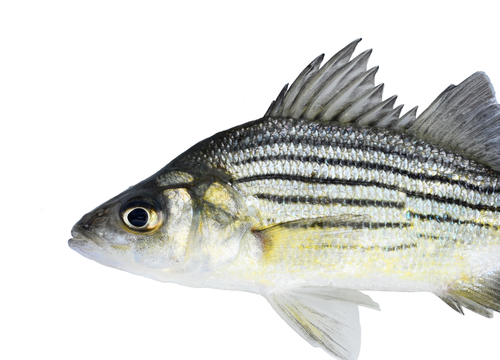
Yellow Bass
Morone mississippiensis
With its brilliant brassy scales and bold racing stripes, the Yellow Bass is a striking inhabitant of North America's quiet waterways. A social and spirited hunter, this species brings a flash of gold to underwater backyard viewing.
Quick Identification
Size
Typically 6-12 inches (15-30 cm) long; weighs between 0.5-1.5 lbs (0.2-0.7 kg).
Colors
Brassy to silvery-yellow body with 5-7 dark horizontal stripes; back is dark olive green.
Key Features
- Horizontal stripes are offset or 'broken' above the anal fin
- Yellowish tint to the belly and lower sides
- No tooth patches on the tongue
- Connected dorsal fins with a deep notch.
When You’ll See Them
Behavior
Yellow Bass are energetic schooling fish that thrive in the quiet, often murky waters of large rivers, backwater sloughs, and reservoirs. Unlike their larger cousins, they are highly social throughout their lives, often traveling in large groups to hunt for forage fish. They are particularly active during the spring when they migrate to shallower rocky or gravelly areas to spawn, a time when they are most likely to be seen near shorelines and docks.
While they are relatively small, they are aggressive predators within their niche. When a school of Yellow Bass finds a cluster of prey, they exhibit a competitive feeding frenzy. For observers with underwater cameras near residential docks, these fish can be quite entertaining to watch as they dart in and out of submerged vegetation or hover near dock pilings to escape the current and larger predators.
EverydayEarth exclusive
Camera Tips
To capture the Yellow Bass on an underwater camera, placement is everything. These fish love 'structure,' so position your camera near dock pilings, submerged fallen timber, or dense weed beds. Mount the camera about 1 to 3 feet off the bottom, facing toward a clear opening in the vegetation. Because Yellow Bass are crepuscular, ensure your camera has excellent low-light performance or infrared capabilities to catch them during their peak dawn and dusk feeding windows.
If you are filming from a backyard dock, you can attract a school of Yellow Bass by hanging a perforated container of fish meal or canned corn (where local regulations permit) a few feet away from the lens. The scent will draw in baitfish, which in turn will attract the predatory Yellow Bass. Their silvery-yellow scales reflect light beautifully, but can cause 'white-out' on some sensors; if possible, angle the camera slightly downward or away from the direct path of the sun to minimize glare during the day.
During the spring spawn, move your setup to shallower water with a gravel or rocky substrate. This is the best time to see large numbers of fish in a single frame. Set your AI camera's motion sensitivity to high, as the swaying of aquatic plants can sometimes mask the fluid movement of fish. If your software supports it, use 'zone detection' to focus specifically on the area around a submerged log where these fish tend to hover and wait for prey.
Similar Species
Species that look similar or are commonly confused with Yellow Bass.
Frequently Asked Questions
Record Yellow Bass at your habitat
Connect a camera to start building your own species record — AI identifies every visitor automatically.