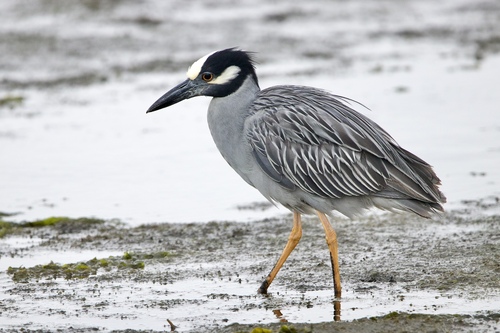
Yellow-crowned Night Heron
Nyctanassa violacea
A dapper, slate-gray stalker with fiery red eyes, the Yellow-crowned Night Heron is the ultimate suburban crustacean hunter. Often found patrolling garden edges at dawn, this elegant bird brings a touch of wild coastal mystery to backyard cameras.
Quick Identification
Size
Length: 55-70 cm (22-28 in); Wingspan: 101-112 cm (40-44 in); Weight: 650-800 g (1.4-1.8 lbs)
Colors
Slate-gray body with a black head featuring a distinct yellowish-white crown and white cheek stripe; adults have striking red eyes and yellow to orange legs.
Key Features
- Thick, heavy black bill designed for crushing shells
- Distinctive white cheek patch against a black face
- Yellowish-white 'cap' or crown on the head
- Long, yellowish legs that extend past the tail in flight
- Stocky, hunched posture compared to Great Blue Herons
When You’ll See Them
Behavior
The Yellow-crowned Night Heron is a patient and methodical hunter, often standing motionless for long periods as it waits for prey to venture within striking distance. Unlike many of its more skittish relatives, this species has adapted remarkably well to suburban environments, frequently seen stalking through manicured lawns or along drainage ditches in coastal neighborhoods.
While they are technically 'night herons,' they are significantly more active during daylight hours than the Black-crowned Night Heron, especially during the breeding season when the demands of hungry chicks require around-the-clock foraging. They are generally solitary hunters but will nest in small, loose colonies, often high up in shade trees that may be blocks away from the nearest water source.
EverydayEarth exclusive
Camera Tips
To capture high-quality footage of a Yellow-crowned Night Heron, focus your camera placement on 'travel corridors' near water. These birds often follow the same paths daily—look for muddy edges of ponds, creek banks, or even the transition zone between a lawn and a wooded area. Position your camera low to the ground (about 12–18 inches high) to get an eye-level perspective of their stalking behavior, which makes for much more compelling footage than a high-angle shot looking down.
If you live in a suburban area, these herons are often attracted to well-watered lawns where crayfish or large insects emerge. Setting your camera to a 'Photo + Video' mode is ideal; the photo captures the bird's still, statuesque poses, while the video will catch the lightning-fast 'strike' when they lunge for a meal. Because they are crepuscular, ensure your camera has high-quality Infrared (IR) LEDs for crisp black-and-white night recording without scaring the bird with a white flash.
While we don't recommend baiting with food, providing a shallow, clean water feature or keeping a portion of your yard slightly damp can naturally attract the crustaceans they hunt. During the spring nesting season (March through May), watch for herons carrying sticks; if you see this, aim your cameras toward tall, leafy trees nearby, as they may be building a nest overhead. High-speed trigger settings are crucial, as their primary movement—the neck thrust—happens in a fraction of a second.
Similar Species
Species that look similar or are commonly confused with Yellow-crowned Night Heron.
Black-crowned Night Heron
Has a distinct black back and white underparts, whereas the Yellow-crowned is mostly gray all over.
Green Heron
Much smaller with a dark green back and chestnut-colored neck; lacks the bold white cheek patch and yellow crown.
Great Blue Heron
Significantly larger with a much longer, thinner neck and a yellow (not black) bill.
Frequently Asked Questions
Record Yellow-crowned Night Heron at your habitat
Connect a camera to start building your own species record — AI identifies every visitor automatically.