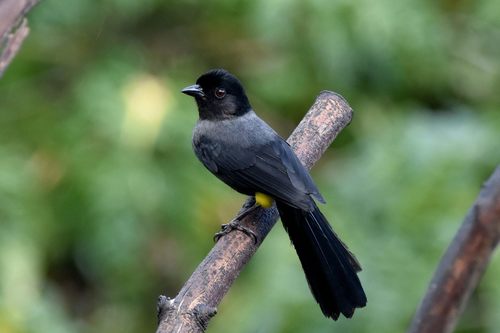
Yellow-thighed Brushfinch
Atlapetes tibialis
Meet the highland specialist with a secret splash of gold. Endemic to the misty cloud forests of Costa Rica and Panama, the Yellow-thighed Brushfinch is a bold, ground-dwelling treasure for backyard observers.
Quick Identification
Size
6.7 to 7.5 inches (17 to 19 cm); 1.1 to 1.4 oz (30 to 40 g)
Colors
Uniformly sooty-grey to charcoal-black body with brilliant, lemon-yellow feathers on the upper legs (thighs). Eyes are a deep reddish-brown. No difference between males and females.
Key Features
- Bright yellow 'thigh' patches often visible when hopping
- Uniformly dark charcoal plumage
- Reddish-brown iris
- Stocky, sparrow-like build with a heavy black bill
When You’ll See Them
Behavior
The Yellow-thighed Brushfinch is a bold and active presence in the high-altitude forests of Central America. Unlike many deep-forest species that remain hidden, these birds are quite curious and frequently venture into garden clearings or along the edges of mountain roads. They are primarily ground-dwellers, moving with a series of confident hops and using a distinctive two-footed scratching technique to uncover insects beneath the damp leaf litter.
Socially, they are almost always found in pairs or small family units. They are highly vocal, often communicating with high-pitched 'tink' calls or squeaky songs. While they spend much of their time near the forest floor, they are also known to join mixed-species foraging flocks, traveling alongside warblers and redstarts through the lower and middle stories of the canopy. Their lack of fear around humans makes them one of the more easily observed endemics in their range.
EverydayEarth exclusive
Camera Tips
To capture high-quality footage of the Yellow-thighed Brushfinch, camera placement is everything. Because these birds are specialized ground-foragers, you should mount your camera very low—ideally between 6 and 12 inches off the ground. Aim the lens toward a natural clearing in the leaf litter near a dense thicket of bamboo or native shrubs. These birds like to have a quick escape route, so they will spend more time in front of the lens if they feel secure near cover.
While they are naturally curious, you can encourage them to linger by creating a dedicated 'scratch zone.' Clear a small patch of earth and cover it with fresh, damp mulch or loose leaves. Hiding a few dried mealworms or small bits of papaya under the leaves will trigger their natural scratching behavior, which makes for fantastic action shots. Position your camera at a 45-degree angle to this zone to ensure the yellow thigh patches—their most defining feature—are clearly visible as they hop and kick back the debris.
Lighting can be a challenge in the shaded cloud forests where these birds thrive. For the best results, place your camera in a spot that receives indirect morning light. Avoid heavy backlight, as the bird's dark, sooty plumage can easily turn into a featureless silhouette. Using a camera with a high-speed trigger is essential; brushfinches are remarkably fast and often 'twitch' while foraging, so a fast shutter speed or high frame rate is necessary to prevent motion blur.
During the nesting season (March through May), look for activity in low bushes. If you notice a pair frequently visiting a specific shrub, place your camera nearby, but maintain a respectful distance to avoid disturbing the nest. If your AI camera has a 'pet' or 'wildlife' detection mode, ensure it is tuned for high sensitivity, as their dark color can sometimes blend into the shadows of the forest floor.
Similar Species
Species that look similar or are commonly confused with Yellow-thighed Brushfinch.
Large-footed Finch
Larger body with a distinctive rufous crown and no yellow on the legs.
Slaty Flowerpiercer
Much smaller with a gray belly and a unique hooked bill for nectar raiding.
Chestnut-capped Brushfinch
Has a bright white throat and a chestnut-colored cap, whereas the Yellow-thighed is almost entirely dark.
Frequently Asked Questions
Record Yellow-thighed Brushfinch at your habitat
Connect a camera to start building your own species record — AI identifies every visitor automatically.