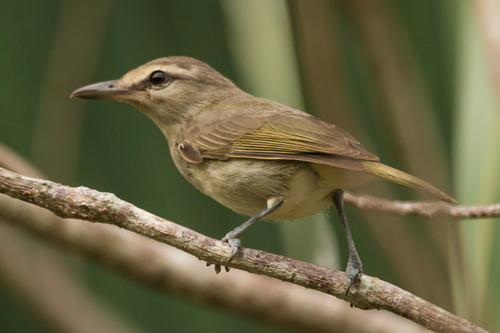
Yucatan Vireo
Vireo magister
A methodical hunter of the tropical canopy, the Yucatan Vireo is a master of camouflage and melody. With its heavy bill and patient demeanor, it is a prized sighting for backyard observers across the Caribbean and Yucatan Peninsula.
Quick Identification
Size
14.5–15.5 cm (5.7–6.1 in) long; wingspan approx. 23 cm (9 in); weight 16–18 g
Colors
Dull olive-grey upperparts, off-white to pale yellow underparts, with a faint pale eyebrow and dark eye-stripe. Males and females look identical.
Key Features
- Large and heavy bill with a distinct hooked tip
- Faint pale eyebrow (supercilium) that fades before reaching the neck
- Uniform olive-grey plumage without wing bars or bold markings
- Deliberate, slow foraging movements compared to warblers
When You’ll See Them
Behavior
The Yucatan Vireo is a patient and methodical forager, often described as moving with a calculated grace. Unlike the frantic, high-energy hopping of warblers, this species takes its time, often sitting motionless for several seconds while scanning the undersides of leaves for hidden larvae. They are persistent singers, especially during the breeding season, delivering a series of sweet, slurred whistles that can be heard echoing through the coastal scrub.
While they are primarily canopy dwellers, they aren't particularly shy and will occasionally descend to lower levels to investigate potential food sources or water. They are typically found alone or in pairs, though they maintain a watchful eye over their territory. In backyard settings within their range, they are docile and can become quite accustomed to human activity, provided there is enough dense foliage for them to retreat into when they feel exposed.
EverydayEarth exclusive
Camera Tips
To successfully capture a Yucatan Vireo on your AI camera, height is your best friend. These birds are canopy specialists, so a camera mounted at ground level will rarely see them unless they descend for water. Mount your camera between 6 and 8 feet high, perhaps on a sturdy tree trunk or a fence post near a mature tree line. Angle the lens slightly upward to catch them as they glean insects from the mid-story foliage.
Because the Yucatan Vireo is a regular visitor to water sources in the heat of the afternoon, placing a birdbath with a solar-powered dripper or a small fountain is the most effective way to lure them into frame. The sound of moving water is a powerful attractant for this species. Set your camera to take short 10-15 second video clips rather than just stills, as their slow, deliberate head-cocking and scanning behavior is a signature trait that is best appreciated in motion.
Lighting can be tricky in their native tropical habitats. Try to position your camera so it is not facing directly into the morning or evening sun, which can wash out the subtle olive tones that distinguish this bird from other vireos. Using a 'High Sensitivity' motion setting is recommended, as the bird's movements are often subtle and slow, which might fail to trigger less sensitive sensors. If you are placing the camera near a fruiting shrub like a Sea Grape or Gumbo-limbo, ensure there is a clear line of sight through the leaves, as the AI will better identify the bird if its heavy bill and facial stripe are clearly visible.
Similar Species
Species that look similar or are commonly confused with Yucatan Vireo.
Red-eyed Vireo
Features a bold grey crown with black borders and a distinct red iris in adults.
Black-whiskered Vireo
Very similar in color but has a thin, dark 'whisker' stripe extending down from the corner of the mouth.
Warbling Vireo
Smaller and more compact with a significantly smaller, more delicate bill.
Frequently Asked Questions
Record Yucatan Vireo at your habitat
Connect a camera to start building your own species record — AI identifies every visitor automatically.