Plan it
Board cut schedule
Every panel you'll need to cut, sized to actual milled lumber dimensions. Print this page or download the PDF to take into your workshop.
| Panel | Dimensions | Qty | Notes |
|---|---|---|---|
| Front | 9.25″ × 24″ | 1 | Drill 2.5" entrance hole 20" from the bottom, centered; score horizontal 'ladder' grooves on interior below hole. |
| Back | 9.25″ × 28″ | 1 | Provides 2" mounting tabs at top and bottom; pre-drill mounting holes. |
| Side (Left) | 7.75″ × 24″ | 1 | Rip to 7.75" width so it fits between Front and Back panels; miter top at 10 degrees. |
| Side (Right) | 7.75″ × 24″ | 1 | Hinge this panel at the top with two screws to allow for cleanout and refilling with shavings. |
| Roof | 9.25″ × 11″ | 1 | Bevel the back edge at 10 degrees to flush against the backboard; provides a 2" front overhang. |
| Floor | 7.75″ × 7.75″ | 1 | Drill four 1/4" drainage holes and recess 1/4" up from the bottom of the sides. |
Source board layout
All panels are cut from a single 1x10 board. The front, back, and roof utilize the full 9.25" width, while the sides and floor must be ripped down to 7.75" to create the specific square interior volume flickers prefer.
Get materials
Shopping checklist
Check off items as you gather them — your progress is saved in your browser so you can come back to this page anytime.
Build it
Construction notes
- Wood: 3/4-inch (19 mm) or 1-inch (25 mm) untreated cedar or redwood for superior weather resistance and insulation.
- Boards: One 1" x 10" x 10' (120") untreated cedar board provides all necessary panels.
- Hardware: 25x 1-3/4" stainless steel or galvanized deck screws, 2x 2" galvanized finishing nails (used as hinge pins), 1x brass swing latch or stainless steel wood screw (for side door security), Bag of natural cedar shavings (essential for this species), 4x 3" exterior lag bolts for mounting
- Ventilation: Leave a 1/2-inch gap between the top of the side panels and the roof, or drill two 5/8-inch holes near the top of each side panel.
- Drainage: Drill at least four 1/4-inch holes in the floor panel to allow moisture to escape and prevent the wood shavings from rotting.
- Predator guard: Use a 24-inch 'stovepipe' or cone baffle on the mounting pole to stop snakes and raccoons. For tree mounts, install a 3-foot section of slick sheet metal around the trunk both above and below the box to prevent squirrel and cat access.
Install it
Place it & time it right
Place the box on the edge of a woodland or in a yard with mature trees and open lawn for foraging. Ensure a clear flight path to the entrance hole and avoid high-traffic areas or spots near bird feeders where competition is high. Mount on a sturdy tree trunk or a heavy-duty pole with a predator baffle.
Seasonal timeline
When to install
Install in late fall or very early winter (January) to allow the birds to scout the location before the spring breeding season.
Nesting begins
Nesting begins as early as March in the Southeast and Southwest. In the Northeast and Midwest, look for activity starting in mid-April to early May as migratory populations return.
Eggs & incubation
5-8 eggs · 11-12 days
Fledging & cleaning
24-28 days after hatching · Clean out the box annually in late summer after the final brood has fledged. Crucially, you must completely refill the box with fresh wood shavings each winter, as Flickers will only use boxes they can 'excavate' themselves.
Regional considerations
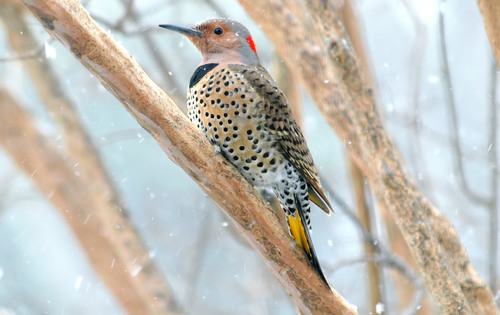
Northern Flickers breed across nearly all of North America, from the tree line in Alaska and Canada down through the entire United States into Mexico. They are particularly common in open woodlands, forest edges, and suburban areas with scattered mature trees.
In southern latitudes, Flickers may start two weeks earlier than those in the north. High-elevation populations in the West often wait until late May or June for the snow to clear and insect activity to peak.
European Starlings are the primary threat, often aggressively evicting Flickers from their cavities. Raccoons and climbing snakes are also major threats to eggs and nestlings if proper baffles are not installed.
Add a camera
Watch it happen
Because Northern Flickers are deep-cavity nesters, interior camera placement is best achieved by mounting a wide-angle, IR-capable camera to the underside of the roof. This top-down view allows you to see the entire nesting area, which is crucial since these birds spend significant time 'excavating' the wood shavings you provide before laying eggs. Ensure the camera has a short focal length to stay in focus at a distance of about 18-22 inches.
Cable routing is straightforward in a Flicker box due to its large size; you can run the power cable through a small notch in the back panel near the roof line. Since Flickers are sensitive to light changes inside the dark cavity, avoid using cameras with visible white LEDs. Instead, rely on 940nm 'invisible' infrared LEDs to observe their fascinating behaviors—from the initial woodchip tossing to the frantic feeding of the large brood—without disturbing the parents.
For external monitoring, a side-mounted camera or a nearby trail cam is excellent for capturing the 'wick-a-wick-a' display calls and the dramatic moment when fledglings first peer out of the 2.5-inch entrance. A rugged outdoor camera like a Blink or a dedicated PoE birdhouse cam works best here, mounted roughly 3-5 feet away on an adjacent branch or a separate post to capture the activity at the hole without obstructing the flight path.
Off-grid power with a USB solar panel
Nest boxes are almost always far from a power outlet. A 5V USB solar panel with a built-in battery is the cleanest solution — it powers most interior USB cameras, Blink cameras (via their USB port), and many trail cameras indefinitely.
- Panel position: Mount on the same post as the box, 1–2 ft above, angled 30–45° from vertical and facing south.
- Cable routing: Run inside split loom or 1/2″ conduit so squirrels can't chew it. Enter through the same grommeted hole as the camera cable.
- Battery buffer: Pick a panel with a 5–10 Ah battery so the camera runs through cloudy days and overnight for nocturnal species.
- Weatherproofing: Wrap every cable connection in self-amalgamating rubber tape.
Troubleshoot
Common problems & solutions
European Starlings taking over
Flickers are larger and can often defend themselves, but you should completely pack the box with shavings. Starlings are less likely to put in the work to remove them, whereas Flickers enjoy the process.
Birds not using the box
Ensure the box is packed tightly with cedar shavings to the very top. Flickers won't nest in an empty box; they need to 'dig' out the cavity to feel it is a suitable site.
Squirrels enlarging the hole
Attach a metal portal protector or a piece of slate with a 2.5" hole over the entrance to prevent chewing.
Box is too hot
Ensure the roof has an adequate overhang and that the box is not painted a dark color; natural cedar or light stains are best.
Common questions
Frequently asked questions
The entrance hole must be exactly 2.5 inches (64 mm) in diameter. This size is large enough for the Flicker but small enough to discourage larger predators and some competing species.
Flickers prefer boxes mounted between 6 and 20 feet high. Higher placement (12+ feet) is generally more successful in areas with significant human or predator activity.
Put the box up by January or February. Flickers begin scouting for nest sites well before they actually lay eggs, and it gives them time to 'excavate' the shavings.
An eastern or southeastern exposure is ideal. This protects the entrance from prevailing winds and the hottest afternoon sun while allowing the birds to wake up with the morning light.
The most effective method is to pack the entire box tightly with wood shavings. Starlings prefer an open cavity, while Flickers are biologically driven to excavate the shavings before nesting.
Northern Flickers typically raise only one brood per year, although they may attempt a second if the first nest fails early in the season.
Clean the box in late autumn after all nesting activity has ceased. Remove the old debris and always refill it to the top with fresh wood shavings for the next season.
Take it with you
Download free PDF plans
Get a printable PDF with materials list, dimensions, assembly notes, and a QR code back to this page. We'll send occasional updates on new plans and habitat tips — unsubscribe anytime.
Prefer not to share your email? View materials online — everything is free and visible on this page.