Plan it
Board cut schedule
Every panel you'll need to cut, sized to actual milled lumber dimensions. Print this page or download the PDF to take into your workshop.
| Panel | Dimensions | Qty | Notes |
|---|---|---|---|
| Front | 5.5″ × 8.5″ | 1 | Drill 1.25" entrance hole 6.5" from bottom, centered |
| Back | 5.5″ × 16″ | 1 | Extends 4" above and 3.5" below box for mounting; pre-drill screw holes |
| Side (Fixed) | 5.5″ × 9.5″ | 1 | Angle top edge from 9.5" back to 8.5" front for roof slope |
| Side (Hinged) | 5.5″ × 9.25″ | 1 | Shorten by 1/4" at bottom for opening clearance; hinge at top with two screws |
| Roof | 5.5″ × 9″ | 1 | Provides a 2-inch front overhang to protect the entrance from rain |
| Floor | 4″ × 4″ | 1 | Recess 1/4" inside the walls; trim corners 1/2" for drainage |
Source board layout
All panels are cut from a standard 1x6 (5.5" actual width). The floor must be ripped to 4" wide to fit between the two side panels. The hinged side should be fastened with two screws near the top to act as a pivot point for cleaning.
Get materials
Shopping checklist
Check off items as you gather them — your progress is saved in your browser so you can come back to this page anytime.
Build it
Construction notes
- Wood: 3/4-inch (19 mm) untreated cedar or cypress. Never use pressure-treated wood or paint the interior.
- Boards: One 1" x 6" x 6' untreated cedar board yields all six panels
- Hardware: 20x 1-5/8" galvanized deck screws, 2x 1-1/2" brass or stainless steel hinges (optional, or use pivot screws), 1x small gate latch or screw eye, 2x 3" mounting lag bolts, 1x 1/2" wire mesh floor liner (optional)
- Ventilation: Leave a 1/4" gap between the top of the side panels and the roof, or drill two 3/8" holes in the upper sides.
- Drainage: Clip the four corners of the floor panel at a 45-degree angle (1/2" across) to allow for moisture drainage.
- Predator guard: Since these boxes are often over water, a 36-inch (91 cm) stovepipe baffle or a large conical metal guard is essential to stop climbing raccoons and water snakes. Ensure the pole is smooth metal (conduit or pipe) rather than wood.
Install it
Place it & time it right
Mount the box on a pole over standing water or within 100 feet of a forested wetland edge. Space boxes at least 100 feet (30 m) apart to reduce territorial disputes and avoid areas with heavy insecticide use, as these birds rely on aquatic insects.
Seasonal timeline
When to install
Install by late March in the Southern US and by mid-April in the Northern range to catch early arrivals.
Nesting begins
In the Southeast, nesting typically begins in early April as cypress swamps warm up. In the Midwest and Northeast, birds arrive later, with nesting usually commencing by mid-to-late May. Timing is closely tied to the emergence of aquatic insect populations.
Eggs & incubation
4-6 eggs (usually 5) · 12-14 days
Fledging & cleaning
10-12 days after hatching · Clean the box immediately after the first brood fledges, as they often raise two broods per year in southern climates. Conduct a final thorough cleaning in late autumn.
Regional considerations
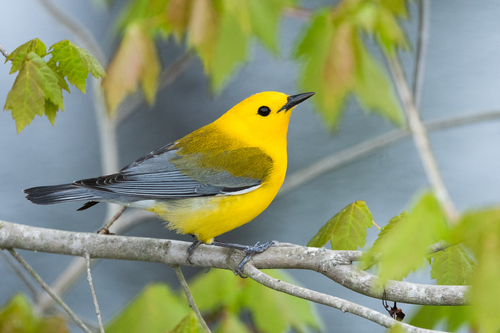
This species breeds across the Southeast, Mid-Atlantic, and Midwest US, specifically in bottomland hardwood forests and wooded swamps. Their range extends as far north as southern Ontario and west to eastern Kansas and Oklahoma.
Nesting begins significantly earlier in the Deep South due to warmer temperatures and earlier insect emergence. High-water events in river basins can occasionally flood low-mounted boxes, leading to second-attempt nests later in June.
The primary threats are raccoons and rat snakes, which are excellent swimmers and climbers. A metal pole with a properly installed stovepipe baffle is the most effective way to prevent these predators from reaching the cavity.
Add a camera
Watch it happen
For Prothonotary Warblers, a small, high-resolution USB 'cube' camera or a specialized bird box camera is the best choice for interior viewing. These birds build nests using deep layers of moss, so the camera should be mounted to the ceiling looking straight down to ensure the lens isn't obscured as the nest grows taller during the season.
Because these warblers often nest in shaded swampy areas, an IR-capable (night vision) camera is mandatory. Even during the day, the interior of a box in a wooded swamp is often too dark for standard color sensors without supplemental infrared light. Avoid cameras with bright white LEDs, as these can disturb the mother while she is brooding.
Cable routing requires careful planning; notch the back panel at the top corner to allow the USB or power cable to exit without being pinched by the roof. If using a wireless camera, ensure your home Wi-Fi signal reaches the wetland area, or consider a long-range outdoor access point. For those without power at the water's edge, a solar-powered exterior camera mounted on a nearby tree can capture the spectacular sight of the male feeding the female at the entrance.
Off-grid power with a USB solar panel
Nest boxes are almost always far from a power outlet. A 5V USB solar panel with a built-in battery is the cleanest solution — it powers most interior USB cameras, Blink cameras (via their USB port), and many trail cameras indefinitely.
- Panel position: Mount on the same post as the box, 1–2 ft above, angled 30–45° from vertical and facing south.
- Cable routing: Run inside split loom or 1/2″ conduit so squirrels can't chew it. Enter through the same grommeted hole as the camera cable.
- Battery buffer: Pick a panel with a 5–10 Ah battery so the camera runs through cloudy days and overnight for nocturnal species.
- Weatherproofing: Wrap every cable connection in self-amalgamating rubber tape.
Troubleshoot
Common problems & solutions
House Wren competition
Avoid placing boxes too deep in the dry brush; House Wrens prefer thickets, while Prothonotaries prefer open water or very damp ground.
Box flooding
Check historical water marks on trees; mount the box at least 4 feet above the highest anticipated spring flood level.
Blowfly larvae
If the nest appears damp and infested, the moss base may need a light cleaning after the first brood to ensure a healthy second brood.
Wasps
Rub a thin layer of unscented bar soap on the interior roof in early spring to prevent paper wasps from attaching their combs.
Common questions
Frequently asked questions
The ideal entrance hole is exactly 1.25 inches (32 mm). This size allows the warbler to enter easily while excluding larger competitors like European Starlings.
Mount the box between 4 and 7 feet (1.2-2.1 m) above the water or ground. This low height mimics their natural cavity locations in rotted stumps.
The box should be in place by March 15th in the South and April 1st in the North to ensure it is available when the first males arrive to claim territories.
Facing the box South or Southeast is generally best to provide warmth in the morning while avoiding the most intense afternoon sun and prevailing wind-driven rain.
The best way is placement; House Wrens are less likely to use a box that is mounted on a pole directly over standing water, which is the Prothonotary's preferred habitat.
In the southern parts of their range, they frequently raise two broods per year. In the northern regions, they typically raise only one.
Clean the box in late summer after the final brood has fledged, or in early spring before the birds return. If they are double-brooding, a quick clean-out between broods is beneficial.
Take it with you
Download free PDF plans
Get a printable PDF with materials list, dimensions, assembly notes, and a QR code back to this page. We'll send occasional updates on new plans and habitat tips — unsubscribe anytime.
Prefer not to share your email? View materials online — everything is free and visible on this page.