Plan it
Board cut schedule
Every panel you'll need to cut, sized to actual milled lumber dimensions. Print this page or download the PDF to take into your workshop.
| Panel | Dimensions | Qty | Notes |
|---|---|---|---|
| Front | 5.75″ × 9.25″ | 1 | Drill 1.5" entrance hole 7" from bottom, centered; rip width to 5.75" |
| Back | 5.75″ × 16″ | 1 | Extends for mounting; rip width to 5.75" |
| Side | 7.25″ × 9.25″ | 2 | Angle top edge from 9.25" down to 8.25" to shed water |
| Roof | 7.25″ × 11″ | 1 | Use full board width; allows for a 2-inch front overhang |
| Floor | 5.75″ × 5.75″ | 1 | Rip to 5.75" square; trim corners 1/2" for drainage |
Source board layout
The roof and sides utilize the full 7.25-inch width of the 1x8 board. The front, back, and floor must be ripped down to 5.75 inches to fit between the side panels. This creates a spacious interior for the swallow's large feather-lined nests.
Get materials
Shopping checklist
Check off items as you gather them — your progress is saved in your browser so you can come back to this page anytime.
Build it
Construction notes
- Wood: 3/4-inch (19 mm) untreated cedar, pine, or redwood. Never pressure-treated.
- Boards: 1x 1" x 8" x 6' untreated cedar board yields all panels.
- Hardware: 20x 1-5/8" galvanized deck screws, 2x 1-1/2" exterior hinges (for side-opening door), 1x small latch or locking screw, 2x 3" lag screws for mounting
- Ventilation: Leave a 1/4-inch gap between the top of the side panels and the roof, or drill two 1/2-inch holes in each side near the top.
- Drainage: Clip all four corners of the floor panel at a 45-degree angle (about 1/2 inch) to ensure water can escape and air can circulate.
- Predator guard: A 24-inch (61 cm) stovepipe baffle mounted on the pole below the box is essential. For areas with high sparrow pressure, an entrance hole precisely 1.5 inches prevents larger competitors like starlings from entering.
Install it
Place it & time it right
Place in open areas with low vegetation, preferably near a water source like a pond or marsh where insects are plentiful. Space boxes at least 100 feet apart for swallow-only colonies, or pair them within 20 feet of a bluebird box to reduce inter-species competition.
Seasonal timeline
When to install
Late February to mid-March in the northern US; late January in the southern range.
Nesting begins
In the Southeast and West, nesting can begin in early April. Midwest and Northeast populations typically wait until May, following the emergence of flying aquatic insects.
Eggs & incubation
4-7 eggs (usually 5-6) · 14-15 days
Fledging & cleaning
18-22 days after hatching · Remove the feather-lined nest immediately after the first brood fledges in mid-summer. Perform a deep cleaning with a 10% bleach solution in late fall once the birds have migrated south.
Regional considerations
Tree Swallows breed throughout the Northern United States, all of Canada up to the tree line, and high-elevation areas of the West. They are particularly common near freshwater lakes, marshes, and agricultural fields.
Nesting timing is heavily influenced by 'insect air-time'; southern populations may begin in March, while those in the Canadian Rockies or Northern Maine may wait until June for consistent warm weather.
Raccoons, snakes, and House Sparrows are the primary threats. A metal mounting pole with a baffle prevents climbing predators, while the 1.5-inch hole and open-field placement help deter House Sparrows.
Add a camera
Watch it happen
For Tree Swallows, an interior camera mounted to the underside of the roof is the gold standard. Because these birds build deep nests of grass and line them with scavenged white feathers, a top-down view ensures you can see into the 'feather cup' to observe eggs and hatchlings. Use a small, wide-angle USB-powered camera with infrared (IR) capabilities; avoid white LEDs as they can disturb the birds during the night. Route the cable through a small notch at the top of a side panel, ensuring it is stapled flat to avoid snagging the adult birds' wings.
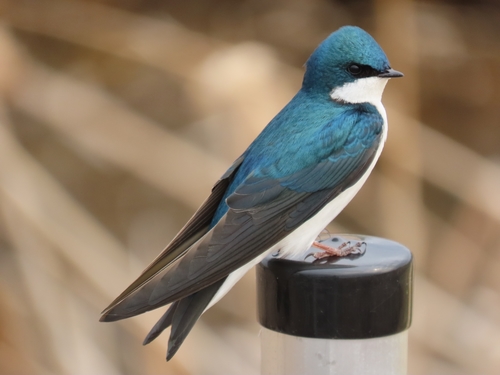
If you prefer an exterior view, place an outdoor wireless camera on a separate post approximately 4 to 6 feet from the entrance hole. Tree Swallows are extremely active flyers, and an exterior camera will capture their spectacular aerial displays and the moment the male presents feathers to the female. Ensure the camera faces North or South to avoid lens flare from the sun, which can wash out the brilliant iridescent blue of their plumage.
For more advanced monitoring, a trail camera with a high-speed trigger is useful for capturing the rapid 'in-and-out' feeding sessions. Tree Swallows feed their young almost constantly during daylight hours, and a fast shutter speed is required to freeze the motion of their wings. If using an interior camera, ensure it is set to a high enough frame rate to capture the vibration of their throat during their liquid, chattering songs.
Off-grid power with a USB solar panel
Nest boxes are almost always far from a power outlet. A 5V USB solar panel with a built-in battery is the cleanest solution — it powers most interior USB cameras, Blink cameras (via their USB port), and many trail cameras indefinitely.
- Panel position: Mount on the same post as the box, 1–2 ft above, angled 30–45° from vertical and facing south.
- Cable routing: Run inside split loom or 1/2″ conduit so squirrels can't chew it. Enter through the same grommeted hole as the camera cable.
- Battery buffer: Pick a panel with a 5–10 Ah battery so the camera runs through cloudy days and overnight for nocturnal species.
- Weatherproofing: Wrap every cable connection in self-amalgamating rubber tape.
Troubleshoot
Common problems & solutions
House sparrow competition
Place boxes at least 100 feet from buildings and monitor weekly; remove sparrow nests immediately to discourage them.
Blowfly larvae in nest
If nestlings look pale or weak, check for larvae under the nest; replace heavily infested nesting material with clean, dry grass if necessary.
Swallows and Bluebirds fighting
Pair your boxes by placing two units 15-20 feet apart; the two species will each take one and then jointly defend the area from others.
Overheating in summer
Ensure 1/4" ventilation gaps at the top and use light-colored cedar; do not paint or stain the box a dark color.
Common questions
Frequently asked questions
A Tree Swallow nest box requires a 1.5-inch (38 mm) entrance hole. This size allows both Tree Swallows and Eastern Bluebirds to enter while excluding larger invasive species like European Starlings.
Mount the box 5 to 6 feet (1.5–1.8 m) above the ground on a metal pole. This height provides good visibility for the birds and easy access for you to monitor and clean the box.
Put boxes up by late February or early March. Tree Swallows are early migrants and scouts often begin looking for nesting sites as soon as they arrive from their wintering grounds.
Face the box east or northeast. This allows the morning sun to warm the box after a cool night but protects the interior from the scorching heat of the afternoon sun.
Place the box in wide-open areas far from houses and barns. If House Sparrows begin to build, remove their nests daily; they prefer to be near human structures while swallows prefer open fields.
Tree Swallows typically raise only one brood per year, though they may attempt a second if the first one fails very early in the season.
Clean the box immediately after the chicks fledge in summer. Tree Swallows are prone to nest parasites, so a mid-season and post-season cleaning is highly recommended.
Take it with you
Download free PDF plans
Get a printable PDF with materials list, dimensions, assembly notes, and a QR code back to this page. We'll send occasional updates on new plans and habitat tips — unsubscribe anytime.
Prefer not to share your email? View materials online — everything is free and visible on this page.