Plan it
Board cut schedule
Every panel you'll need to cut, sized to actual milled lumber dimensions. Print this page or download the PDF to take into your workshop.
| Panel | Dimensions | Qty | Notes |
|---|---|---|---|
| Back | 7.25″ × 16″ | 1 | Provides a large surface area for mounting to a tree or post; drill pilot holes at top and bottom. |
| Floor | 7.25″ × 7″ | 1 | Drill four 1/4" drainage holes; use a slight gap at the back for moisture runoff. |
| Sides | 7.25″ × 9″ | 2 | Cut the top edge at a 15-degree angle to shed water forward away from the open front. |
| Roof | 7.25″ × 10″ | 1 | Install with a 2-inch overhang at the front to protect the nest from heavy rain. |
Source board layout
This open-front design (nesting shelf) is optimized for 1x8 lumber. All panels are the same width (7.25") as the board, requiring only cross-cuts and one angled cut for the sides. Ensure the roof is the last piece cut to maximize the overhang based on your remaining scrap.
Get materials
Shopping checklist
Check off items as you gather them — your progress is saved in your browser so you can come back to this page anytime.
Build it
Construction notes
- Wood: 3/4-inch (19 mm) untreated red cedar or cypress for superior rot resistance in damp forest environments.
- Boards: A single 1x8 x 6' untreated cedar board provides enough material for the platform and a generous protective roof.
- Hardware: 18x 1-5/8" stainless steel or galvanized deck screws, 2x 3" galvanized lag bolts for tree mounting, Exterior wood glue (optional)
- Ventilation: The open-front design provides natural airflow; ensure the side walls have a 1/2-inch gap at the very top under the roof for additional heat escape.
- Drainage: Drill four 3/8-inch holes in the floor panel corners to prevent the mud-base of the thrush nest from becoming waterlogged.
- Predator guard: Since this is an open shelf, mount on a 4x4 post with a large 24-inch stovepipe baffle. If tree-mounting, ensure the shelf is far from 'ladder' branches that allow squirrels or raccoons easy access.
Install it
Place it & time it right
Place in a well-shaded area with a dense understory, preferably near a water source or damp ground where they gather mud. Avoid high-traffic areas; these birds prefer the quiet interior of a woodlot or a very mature, 'leafy' backyard corner.
Seasonal timeline
When to install
Early to mid-April in the South; late April to early May in the North and Midwest.
Nesting begins
Nesting typically begins in early May in the Southeast and Midwest, extending into June in the Northeast and Canada. They often attempt two broods if the first is successful, continuing activity through July.
Eggs & incubation
3-4 eggs · 12-14 days
Fledging & cleaning
12-15 days after hatching · Remove old nesting material in late autumn after the birds have migrated to Central America. Scrub the shelf with a weak bleach solution (1:10) to kill parasites.
Regional considerations
Wood Thrushes breed throughout the Eastern United States and Southeast Canada, from the Atlantic coast west to the eastern Great Plains. They are most common in mature deciduous and mixed forests with a healthy leaf litter layer.
In the Southern US, nesting may start as early as mid-April, whereas in higher elevations of the Appalachians or the northern edge of their range, they may wait until late May for consistent insect availability.
The main threats are raccoons, Blue Jays, and Brown-headed Cowbirds. The shelf's deep roof protects against aerial predators, while a pole-mounted baffle is the best defense against climbing mammals.
Add a camera
Watch it happen
Because the Wood Thrush uses an open nesting shelf rather than a cavity, interior camera mounting is not an option. Instead, you should focus on a 'branch-mount' setup. Position a weatherproof, AI-powered camera like a Blink Outdoor or a high-definition trail camera on a neighboring branch or a separate post about 4 to 6 feet away from the shelf. This provides a wide-angle view of the parents arriving with food and mud.
Wood Thrushes are interior forest birds and are highly sensitive to sudden changes in their environment. Avoid cameras with bright white LEDs or status lights that blink; choose a model with 'No-Glow' or 'Black' Infrared (IR) for nighttime monitoring. This ensures the birds aren't spooked during the vulnerable incubation phase.
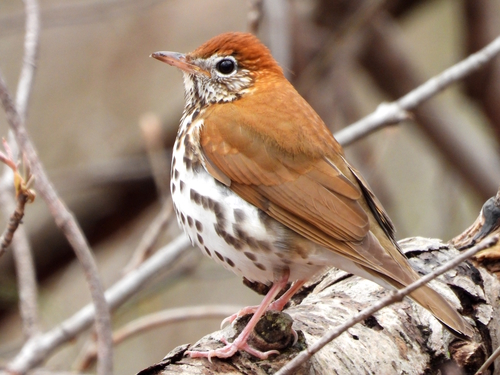
Route any necessary power cables tightly along the underside of the mounting branch or down the back of the post using cable staples to prevent them from becoming a perch for predators or an obstruction for the birds. A side-on angle is usually superior to a top-down view for Wood Thrushes, as it allows you to see the unique speckled chests of the parents as they tend the nest.
Consider a camera with a high-quality microphone. The Wood Thrush's song is its most distinctive feature, and capturing the male singing from a nearby 'song perch' while the female is on the nest adds a significant layer to the observation experience.
Off-grid power with a USB solar panel
Nest boxes are almost always far from a power outlet. A 5V USB solar panel with a built-in battery is the cleanest solution — it powers most interior USB cameras, Blink cameras (via their USB port), and many trail cameras indefinitely.
- Panel position: Mount on the same post as the box, 1–2 ft above, angled 30–45° from vertical and facing south.
- Cable routing: Run inside split loom or 1/2″ conduit so squirrels can't chew it. Enter through the same grommeted hole as the camera cable.
- Battery buffer: Pick a panel with a 5–10 Ah battery so the camera runs through cloudy days and overnight for nocturnal species.
- Weatherproofing: Wrap every cable connection in self-amalgamating rubber tape.
Troubleshoot
Common problems & solutions
Brown-headed Cowbird parasitism
Wood Thrushes are frequent hosts; ensure the shelf is placed in deeper woods rather than forest 'edges' where cowbirds are most active.
Nest falls off platform
Add a 1-inch tall 'toe kick' strip of wood across the front of the floor to act as a retaining wall for the mud nest.
Blue Jay or Crow predation
Mount the shelf under a dense canopy of leaves to provide natural overhead concealment from sharp-eyed corvids.
Shelf remains empty
Ensure the location is quiet and damp; Wood Thrushes require mud to build their nests and will avoid dry, noisy suburban yards.
Common questions
Frequently asked questions
Wood Thrushes do not use traditional nest boxes with holes; they require an open-fronted nesting shelf. The 'entrance' is the entire open front of the platform, roughly 7.25 inches wide.
Mount the nesting shelf between 6 and 15 feet high. While they sometimes nest lower in shrubs, a height of 10 feet in a mature tree offers the best protection from ground predators.
Have your shelf installed by early April. This allows the bird to find the platform as soon as it returns from its migration to Central America.
Face the shelf North or Northeast. Wood Thrushes are birds of the cool, damp forest interior and their eggs can easily overheat if exposed to direct afternoon sun.
House Sparrows usually prefer enclosed cavities and are less likely to use an open shelf in the deep shade. If they do interfere, move the shelf further into the wooded area away from open lawns.
Wood Thrushes typically raise two broods per season, especially in the southern and central parts of their range.
Take it with you
Download free PDF plans
Get a printable PDF with materials list, dimensions, assembly notes, and a QR code back to this page. We'll send occasional updates on new plans and habitat tips — unsubscribe anytime.
Prefer not to share your email? View materials online — everything is free and visible on this page.