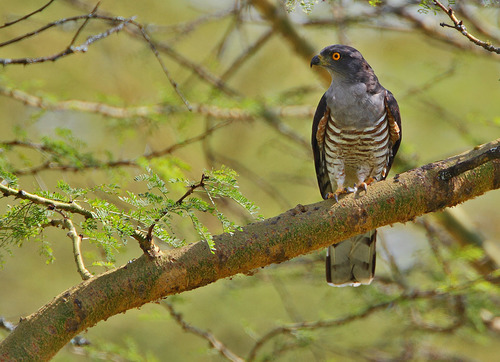
African Cuckoo-Hawk
Aviceda cuculoides
A master of canopy camouflage, the African Cuckoo-Hawk uses its cuckoo-like plumage to move undetected through the trees. This elusive hunter is a prized sighting for any backyard enthusiast across sub-Saharan Africa.
Quick Identification
Size
Length: 38–45 cm (15–18 in); Wingspan: 85–100 cm (33–39 in); Weight: 220–350 g (0.5–0.8 lbs)
Colors
Slate-grey upperparts in males (brownish-grey in females) with distinctive rufous (reddish-brown) barring on a white underbelly. Features a bright yellow iris and yellow legs.
Key Features
- Small pointed crest on the nape of the neck
- Heavy rufous-brown barring on the chest and belly
- Bright yellow eyes and yellow cere
- Cuckoo-like appearance in flight with broad, rounded wings
- Relatively small, hooked hawk bill
When You’ll See Them
Geographic range
Where Does the African Cuckoo-Hawk Live?
The African Cuckoo-Hawk is native to the African continent, maintaining a massive range across sub-Saharan Africa. It is commonly found from the tropical forests of West and Central Africa through to the eastern regions of Kenya and Tanzania, extending south into Zimbabwe, Mozambique, and the eastern parts of South Africa. While it avoids the driest desert regions, it is highly adaptable to moist, well-wooded environments including mountain forests and leafy urban outskirts.
Basemap © OpenStreetMap contributors
Behavior
The African Cuckoo-Hawk is a remarkably secretive raptor that spends much of its time perched quietly within the dense foliage of the mid-to-upper canopy. Unlike many hawks that soar openly in search of prey, this species is a 'sit-and-wait' specialist. It remains motionless for long periods, using its keen eyesight to scan for insects and small reptiles moving among the leaves or on the ground below.
Its resemblance to the Common Cuckoo is thought by some experts to be a form of aggressive mimicry; by looking like a harmless insect-eater, it may avoid scaring off potential prey or prevent smaller birds from mobbing it. While generally solitary or found in pairs, they are most vocal during the breeding season, emitting a distinctive 'tu-ee, tu-ee' whistle that often reveals their presence before they are seen.
EverydayEarth exclusive
Camera Tips
Capturing the African Cuckoo-Hawk on a trail camera requires a strategic approach because they rarely spend time on the ground. To find success, place your AI-powered camera high up in the crotch of a large, mature tree—ideally one that has a clear view of a horizontal branch. These birds love 'lookout' perches where they can sit and scan for chameleons. Use a mounting bracket that allows for a downward angle if you are placing the camera 4-5 meters high.
Because they are insectivores, traditional meat baits used for other raptors rarely work. Instead, focus your camera on 'hotspots' of activity. If you have a garden with many chameleons or a high density of large stick insects, position the camera to face the sunny side of the canopy where these prey items congregate. Water sources are another excellent target; like most raptors, they will occasionally descend to a high-placed birdbath or a quiet garden pond to drink and bathe, especially during the dry season.
Set your camera to 'Burst Mode' with a high shutter speed. The African Cuckoo-Hawk is incredibly fast when it finally decides to strike, often performing a quick 'perch-to-perch' pounce. If your camera has AI bird detection, ensure it is calibrated for medium-sized raptors. Since they are most active in the mid-morning and late afternoon, ensure your camera isn't facing directly into the rising or setting sun, which can wash out the delicate rufous barring on their chest, making identification harder.
Similar Species
Species that look similar or are commonly confused with African Cuckoo-Hawk.
Shikra
Smaller with a distinct red eye in adults and lacks the Cuckoo-Hawk's small nape crest.
Common Cuckoo
Nearly identical plumage, but the Cuckoo has a thinner, straighter bill and lacks the raptor's powerful talons.
African Harrier-Hawk
Much larger with a bare yellow (or red) facial patch and different hunting style involving climbing trees.
Frequently Asked Questions
Record African Cuckoo-Hawk at your habitat
Connect a camera to start building your own species record — AI identifies every visitor automatically.