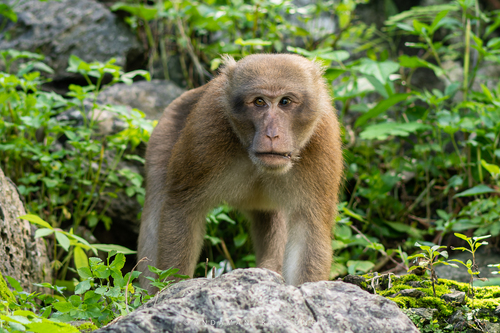
Assam Macaque
Macaca assamensis
A resilient mountain dweller with a soulful gaze, the Assam Macaque thrives in the misty forests of the Himalayas. These social primates offer a fascinating window into the complex world of troop dynamics and high-altitude survival.
Quick Identification
Size
Body length 51-73 cm (20-29 in), tail length 15-30 cm (6-12 in); weight 5-15 kg (11-33 lbs)
Colors
Yellowish to dark brown dorsal fur, lighter cream or grey underparts; facial skin is pinkish to brownish
Key Features
- Stocky, muscular build with a relatively short, hairy tail
- Face is mostly hairless and turns deep pink or red in breeding adults
- Prominent brow ridges and a distinctively 'serious' facial expression
- Thick, dense fur adapted for cooler mountain temperatures
When You’ll See Them
Geographic range
Where Does the Assam Macaque Live?
Native to the rugged landscapes of South and Southeast Asia, the Assam Macaque is a specialist of the Himalayan foothills and surrounding highlands. Its core range spans from eastern Nepal and northern India through Bhutan and Bangladesh, extending eastward into Myanmar, Thailand, Laos, Vietnam, and southern China. These primates are typically mountain dwellers, preferring the lush cover of evergreen and deciduous forests that offer both safety from predators and a steady supply of seasonal fruits.
Basemap © OpenStreetMap contributors
Behavior
The Assam Macaque is a highly social primate that lives in organized troops ranging from 10 to over 50 individuals. These groups are multi-male and multi-female, governed by a complex social hierarchy where grooming plays a vital role in maintaining bonds and reducing tension. While they are primarily diurnal and spend a significant amount of time in the trees, they are frequently seen on the ground foraging for food or traveling between forest patches.
These macaques are known for their intelligence and adaptability. In the wild, they are generally shy and avoid human contact, but in areas where their habitat overlaps with hill stations or temples, they can become quite bold. They communicate using a wide array of vocalizations, from soft grunts used during travel to loud alarm calls when a predator like a leopard is spotted. Their facial expressions are equally diverse, including 'lip-smacking' to show submission or 'staring' to signal a threat.
EverydayEarth exclusive
Camera Tips
When setting up a camera for Assam Macaques, focus on natural 'highways' such as ridgelines, established forest trails, or rocky ledges near water sources. Because they are semi-terrestrial, mount your camera at a height of 2 to 4 feet. Aiming the lens slightly downward across a clear patch of ground will help you capture the full body of the animal as the troop passes by. They often travel in single file, so a wider angle is better than a tight zoom.
Using bait like local fruits (bananas or apples) can be effective in backyard or fringe-forest settings, but use this sparingly to avoid making the animals dependent on humans. Macaques are visually motivated; placing a camera near a fruiting tree (like wild figs) during its ripening season is often more effective than any artificial lure. Be aware that their curiosity is a challenge—these monkeys are incredibly dexterous and may try to investigate or pull at your equipment.
A high-speed trigger and 'Burst Mode' (3-5 photos per trigger) are essential settings. Because they move in groups, a single photo often misses the most interesting social behaviors. Set a short recovery time to ensure you capture the entire troop as they move through the frame. Video mode is particularly rewarding with this species, as it allows you to observe their complex vocalizations and grooming rituals.
Protect your gear. In areas with high macaque activity, a heavy-duty security box (often called a bear box) is highly recommended. These monkeys have been known to smudge lenses with their fingers or even attempt to unscrew mounting brackets. Secure the housing with a python cable lock to a sturdy tree to prevent the camera from being shifted or stolen by a curious alpha male.
Similar Species
Species that look similar or are commonly confused with Assam Macaque.
Rhesus Macaque
Has a longer tail and distinctive orange-red fur on its rump and hind legs.
Tibetan Macaque
Much larger with even thicker, shaggier fur and an extremely short, stump-like tail.
Northern Pig-tailed Macaque
Distinguishable by its thin, 'pig-like' tail that is often carried arched over its back.
Frequently Asked Questions
Record Assam Macaque at your habitat
Connect a camera to start building your own species record — AI identifies every visitor automatically.