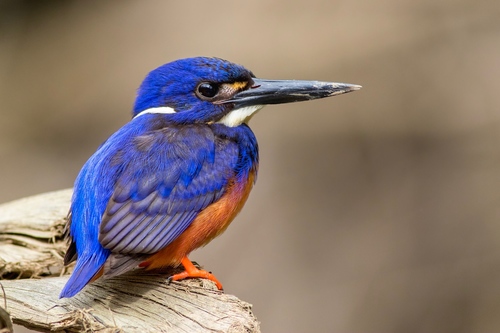
Azure Kingfisher
Ceyx azureus
A shimmering jewel of the waterways, the Azure Kingfisher is a master of the vertical dive. Its brilliant plumage and lightning-fast strikes make it one of the most rewarding species to spot on a backyard water-feature camera.
Quick Identification
Size
Length 17-19 cm (6.7-7.5 in); Wingspan 25-29 cm (10-11.4 in); Weight 30-40g (1.1-1.4 oz)
Colors
Brilliant deep azure blue upperparts; rich rufous-orange underparts; distinctive creamy-white patches on the side of the neck and throat; black bill and bright orange-red feet.
Key Features
- Dagger-like black bill longer than the head
- Deep metallic blue back and wings with vibrant orange belly
- Small, stumpy tail and short red legs
- White 'flash' marks on the sides of the neck
When You’ll See Them
Geographic range
Where Does the Azure Kingfisher Live?
Native to the Oceania region, the Azure Kingfisher is found across northern and eastern Australia, as well as throughout New Guinea, the Moluccas, and the Romang and Kai Islands. In Australia, its range extends from the Kimberley in Western Australia, across the Top End, and down the entire eastern seaboard through Queensland and New South Wales to Victoria and Tasmania. It is a true water specialist, rarely straying far from permanent freshwater or estuarine environments where food is plentiful.
Basemap © OpenStreetMap contributors
Behavior
The Azure Kingfisher is a patient and dedicated hunter, often seen sitting motionless on a low-hanging branch overhanging a stream or pond. From this vantage point, it scans the water for movement with intense focus. Once prey is spotted, it executes a swift, vertical dive, disappearing beneath the surface for a split second before emerging with a fish or small crustacean. It then returns to its perch, where it vigorously thwacks the prey against the wood to stun it before swallowing it head-first.
These birds are highly territorial and generally solitary outside of the breeding season. They fly low and fast over the water's surface, appearing as a brilliant blue streak to any observer. While they are usually shy and wary of humans, they are creatures of habit, often returning to the same favorite perches day after day. Their presence is often announced by a high-pitched, shrill 'peep-peep' whistle that cuts through the sound of running water.
EverydayEarth exclusive
Camera Tips
To capture the Azure Kingfisher, your camera must be positioned near water. Look for low-hanging, horizontal branches that extend 1-2 meters over the surface of a creek or garden pond. These are preferred hunting perches. Mount your camera about 1.5 meters high, angled slightly downward toward the water's edge or a known perching spot. Since these birds are lightning-fast during a dive, use a camera with a high-speed trigger or set it to record short video clips to ensure you don't miss the action.
Natural lures are more effective than artificial bait; if you have a backyard pond, ensuring it is stocked with small native fish or crustaceans will naturally attract them. They are creatures of habit and will often return to the exact same branch multiple times a day. If you spot white droppings (whitewash) on a specific branch or rock near the water, that is your primary target for camera placement, as it indicates a frequently used 'fishing chair.'
Lighting is crucial for bringing out their iridescent blue feathers. Try to position the camera so it faces away from the sun (generally north-facing in Australia) to avoid silhouetting the bird against the water's glare. Early morning light often provides the best color saturation and the most natural activity. Because they are sensitive to movement and unusual objects, ensure your camera is well-camouflaged with local vegetation so the 'blue flash' isn't spooked before it lands.
Similar Species
Species that look similar or are commonly confused with Azure Kingfisher.
Little Kingfisher
Much smaller (11cm) with a more greenish-blue tint and less orange on the flanks.
Forest Kingfisher
Larger with a prominent white collar and white spots in front of the eyes; prefers woodland over open water.
Sacred Kingfisher
Duller turquoise-green coloring with a buff-colored collar and underparts, often found far from water.
Frequently Asked Questions
Record Azure Kingfisher at your habitat
Connect a camera to start building your own species record — AI identifies every visitor automatically.