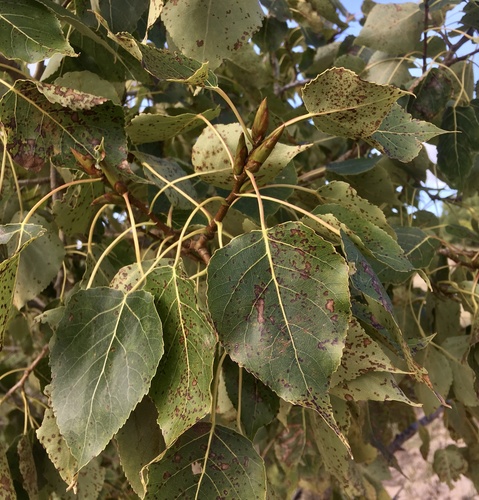
balsam poplar
Populus balsamifera
The balsam poplar is a fragrant giant of the North, famous for its resin-scented spring buds and its vital role in stabilizing the riverbanks of the boreal forest.
Quick Identification
Size
Height 18–30 m (60–100 ft); Trunk diameter 30–100 cm (12–40 in)
Colors
Dark green upper leaves with silvery-white or rusty-stained undersides; grayish-brown furrowed bark
Key Features
- Large, pointed terminal buds coated in fragrant, sticky orange resin
- Simple, ovate leaves with finely toothed margins and a distinct pale underside
- Thick, deeply furrowed grayish bark on mature trunks
- Pendent flower catkins appearing before leaves in spring
When You’ll See Them
Geographic range
Where Does the balsam poplar Live?
The balsam poplar is a quintessential inhabitant of the northern reaches of North America, holding the distinction of being the northernmost hardwood tree on the continent. Its native range is vast, stretching from the edge of the tundra in Alaska and across the entire breadth of Canada to Newfoundland. In the United States, it thrives across the northern tier from Washington and the Rocky Mountains through the Great Lakes region and into New England, typically hugging river valleys and moisture-rich lowlands where it can keep its roots well-hydrated.
Basemap © OpenStreetMap contributors
Behavior
The balsam poplar is a resilient pioneer species, often being one of the first trees to colonize disturbed areas or newly formed riverbanks. It is exceptionally fast-growing and exhibits a remarkable ability to reproduce vegetatively through root suckering, frequently forming dense, clonal groves. Its growth is most vigorous in full sunlight and moist soils, where it serves as a critical stabilizer for riparian ecosystems.
During the spring, the tree is famous for its aromatic resin found on the leaf buds, which produces a sweet, spicy scent that can permeate an entire forest. This resin, often called 'balm of Gilead,' has historically been used for medicinal purposes. While the tree is relatively short-lived compared to hardwoods—seldom exceeding 200 years—it plays a vital role in forest succession, eventually giving way to more shade-tolerant species like spruce or fir.
EverydayEarth exclusive
Camera Tips
Capturing the life of a balsam poplar on a trail camera requires a shift in perspective from animal tracking to environmental documentation. To showcase the tree's impressive stature and bark texture, mount your camera 4 to 6 feet high on a neighboring tree, aiming slightly upward to capture the lower canopy and the main trunk. Using a time-lapse setting is highly recommended; a single photo taken daily at noon can create a breathtaking video sequence showing the resinous buds swelling in spring, the rapid unfurling of leaves, and the vibrant golden-yellow transformation in the autumn.
Because balsam poplars are 'wildlife magnets,' positioning your camera near a mature specimen is a great strategy for capturing animals. The deep furrows in the bark often host insects, which in turn attract nuthatches and various woodpeckers. Aim your camera at the base of the trunk or a low-hanging branch to catch these birds in action. In early spring, the sticky buds are a food source for squirrels and some bird species; a close-focus camera set to record short video clips can capture these unique feeding behaviors that often happen high above the ground.
If your camera is located in a windy area, be mindful of the balsam poplar's long-petioled leaves, which tremble and flutter in the slightest breeze. This can cause frequent false triggers on motion-activated cameras. To mitigate this, set your camera's sensitivity to 'medium' and ensure the 'detection zone' is focused on the solid trunk or the ground area immediately surrounding the tree rather than the leafy periphery. During the winter, the tree's saplings are favored browse for deer and moose, so keep your cameras active year-round to catch these large mammals visiting the tree during the lean months.
Similar Species
Species that look similar or are commonly confused with balsam poplar.
Quaking Aspen
Aspen leaves are more circular and lack the rusty-colored underside; they also have smooth, greenish-white bark compared to the poplar's furrowed gray bark.
Black Cottonwood
Very similar but found mostly west of the Rockies; black cottonwood has 3-valved fruit capsules compared to the balsam poplar's 2-valved capsules.
Eastern Cottonwood
Has more triangular (deltoid) leaves and lacks the intensely fragrant, sticky resin found on balsam poplar buds.
Frequently Asked Questions
Record balsam poplar at your habitat
Connect a camera to start building your own species record — AI identifies every visitor automatically.