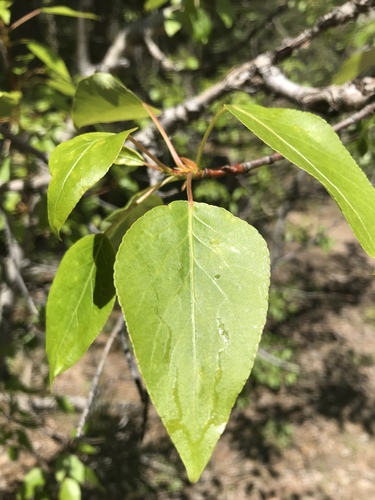
black cottonwood
Populus trichocarpa
The titan of the riverbank, the black cottonwood is the largest poplar species in the Americas, famous for its fragrant spring buds and 'summer snow' of cottony seeds.
Quick Identification
Size
A massive deciduous tree reaching heights of 30–50 meters (100–165 feet) with a trunk diameter of 1–2 meters (3–6.5 feet).
Colors
Dark green upper leaf surfaces with silvery-white or rusty-stained undersides; grey to charcoal deeply furrowed bark; yellowish-orange bud resin.
Key Features
- Large heart-shaped (deltoid) leaves with finely serrated margins
- Sticky, fragrant orange resin on pointed winter buds
- Deeply fissured, thick grey bark on mature trunks
- Prodigious amounts of white, cottony seed fluff released in late spring
When You’ll See Them
Geographic range
Where Does the black cottonwood Live?
Native to western North America, the black cottonwood thrives in the moist corridors of the Pacific coast and the Rocky Mountains. Its range extends from the southern reaches of Alaska and the Yukon, through British Columbia, and down into California and northern Baja California. It is also found inland as far as Montana, Idaho, and Utah, where it clings to river systems and permanent water sources in otherwise arid landscapes.
Basemap © OpenStreetMap contributors
Behavior
The black cottonwood is a fast-growing pioneer species that dominates riparian ecosystems across the Pacific Northwest. It is known for its aggressive growth strategy, often colonizing bare mineral soil after floods or fires. In the spring, the tree's sticky buds burst open, releasing a potent, sweet balsamic fragrance that can be smelled from a distance, signifying the start of the growing season.
As a foundational species, it provides critical structural complexity to its environment. During late May and June, female trees release millions of tiny seeds attached to cotton-like hairs, creating a 'summer snow' effect that can blanket the ground. This tree interacts significantly with humans as a source of shade and timber, though its brittle wood means large branches frequently drop during windstorms, a process that actually helps create nesting cavities for local wildlife.
EverydayEarth exclusive
Camera Tips
Capturing the majesty of a black cottonwood on a trail camera requires a focus on the wildlife it supports rather than just the tree itself. Because these trees are often the tallest structures in a riparian corridor, they serve as 'wildlife hubs.' Mount your camera on a neighboring tree at a height of 5-6 feet, angled toward the cottonwood's base or a low-hanging branch. Many mammals, including bears and cougars, use the thick, furrowed bark of the black cottonwood as 'rub trees' to leave their scent; look for clumps of fur caught in the bark fissures to find the perfect spot.
In the spring, use a time-lapse setting to capture the dramatic 'snowfall' of cotton. If your camera has a high-quality microphone, the rustling of cottonwood leaves—which have flattened petioles that cause them to flutter in the slightest breeze—provides an iconic auditory backdrop. For backyard setups, position your camera near a cottonwood during the nesting season. The soft seed fluff is a primary nesting material for dozens of bird species, and you can capture high-quality footage of birds 'harvesting' the cotton from the ground or low branches.
Be mindful of the lighting; the silvery undersides of the leaves can cause significant 'white-out' or glare on your sensor during windy, sunny days. Set your exposure compensation slightly lower if your camera allows it. If you are monitoring the tree for visitors like Wood Ducks or Bald Eagles that nest in the upper canopy, consider a 'sky-cam' angle or placing the camera on a high slope overlooking the tree's crown.
Similar Species
Species that look similar or are commonly confused with black cottonwood.
Quaking Aspen
Aspens have smooth white bark and smaller, circular leaves that turn bright gold in autumn.
Eastern Cottonwood
Found primarily east of the Rockies; its leaves are more triangular and lack the silver-rusty staining on the underside.
Balsam Poplar
Very closely related but typically smaller, with narrower leaves and a more northern/boreal distribution.
Frequently Asked Questions
Record black cottonwood at your habitat
Connect a camera to start building your own species record — AI identifies every visitor automatically.