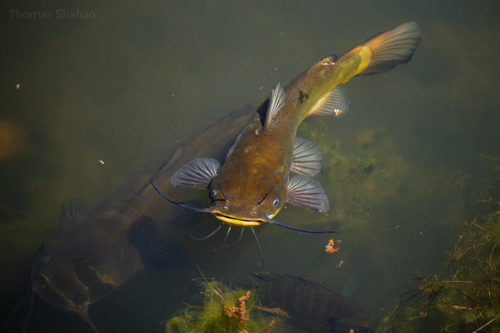
Black Bullhead
Ameiurus melas
The ultimate survivor of the underwater world, the Black Bullhead is a whiskered scavenger that thrives in the murky depths of backyard ponds and slow-moving creeks.
Quick Identification
Size
Typically 6–14 inches (15–36 cm) long; weight usually 1–2 lbs (0.45–0.9 kg), rarely reaching 4 lbs (1.8 kg)
Colors
Dark black to olive-brown dorsal side with yellow or white belly; distinct black barbels (whiskers) and a tan crescent-shaped band at the base of the tail
Key Features
- Jet-black chin barbels
- Tan or light-colored crescent at the base of the tail
- Square-shaped (truncated) tail fin
- Smooth, scale-less skin with a broad, flattened head
When You’ll See Them
Geographic range
Where Does the Black Bullhead Live?
Native to the central and eastern regions of North America, the Black Bullhead thrives across a massive range extending from southern Canada through the Great Lakes and down to the Gulf Coast of Mexico. While its heartland is the Mississippi River basin, it has been widely introduced to the Western United States and several European countries, where it frequently establishes dominant populations in murky or disturbed waterways.
Basemap © OpenStreetMap contributors
Behavior
The Black Bullhead is a master of survival, known for its incredible resilience in environments that would be lethal to most other fish. They are highly tolerant of low oxygen levels, high water temperatures, and heavy siltation. While they are primarily nocturnal, emerging from the depths or vegetation at night to forage, younger individuals are often observed feeding during daylight hours. They are social as juveniles, frequently forming dense, swirling 'balls' or schools for protection, but they become more solitary and territorial as they reach adulthood.
In the backyard pond or local creek, these catfish are the ultimate 'cleanup crew.' They spend their time patrolling the bottom, using their highly sensitive barbels to detect chemical signals from potential food in the mud. While they aren't aggressive toward humans, they possess sharp, serrated spines on their dorsal and pectoral fins that can deliver a painful 'sting' (actually a mild toxin and mechanical puncture) if handled carelessly.
EverydayEarth exclusive
Camera Tips
Capturing a Black Bullhead on camera requires an underwater setup, such as an action camera with a waterproof housing or a specialized aquatic AI camera. For the best results in a backyard pond or creek, place your camera on a weighted tripod or a flat stone at a depth of 1 to 3 feet. Angle the lens slightly downward toward a patch of clear mud or sand where the catfish are likely to forage. Because they are nocturnal, ensure your camera has strong infrared (IR) capabilities or use a dim, red underwater light to illuminate the area without spooking the fish.
To guarantee a 'visit,' use scent-based lures. Black Bullheads have an extraordinary sense of smell. Placing a small mesh bag filled with stinky baits like chicken liver, canned corn, or crushed dog food just inside the camera's field of view will draw them in quickly. If you are using an AI-powered camera, the distinctive whiskered silhouette is usually easy for the software to identify even in turbid water.
Be mindful of water clarity. While Bullheads love murky water, your camera doesn't. Try to set up your station near a structure like a submerged log or rock pile during a period of dry weather when the sediment has settled. Late spring and early summer are the best times for action, as you may catch footage of adults guarding their nests or the fascinating sight of 'clouds' of jet-black fry swimming in a tight ball.
Similar Species
Species that look similar or are commonly confused with Black Bullhead.
Yellow Bullhead
Features white or pale yellow chin barbels and a slightly more rounded tail compared to the black whiskers of the Black Bullhead.
Brown Bullhead
Distinguished by a mottled or 'marbled' skin pattern on its sides, whereas the Black Bullhead is usually a solid dark color.
Channel Catfish
Has a deeply forked tail and often displays small dark spots on its silvery sides, unlike the square-tailed bullhead.
Frequently Asked Questions
Record Black Bullhead at your habitat
Connect a camera to start building your own species record — AI identifies every visitor automatically.