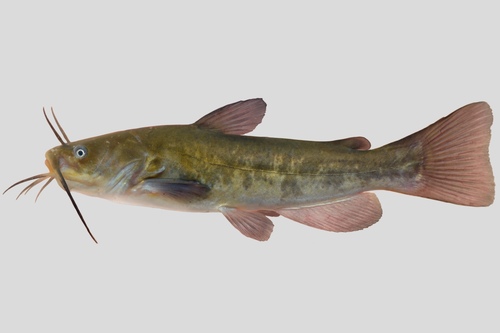
Brown Bullhead
Ameiurus nebulosus
Meet the Brown Bullhead, a whiskered survivor that thrives where others can't. From its devoted parenting to its nocturnal mud-scavenging, this resilient catfish is a fascinating neighbor in backyard ponds and local lakes.
Quick Identification
Size
Typically 8 to 14 inches (20 to 36 cm) in length and weighing 1 to 2 lbs (0.45 to 0.9 kg), though record specimens can reach 20 inches and 8 lbs.
Colors
Mottled olive-brown to dark brown on the back and sides, often appearing 'cloudy'; the belly is creamy white or pale yellow. Barbels (whiskers) are dark brown or black.
Key Features
- Distinctive mottled or clouded skin pattern
- Eight dark chin barbels (whiskers) around the mouth
- Strongly serrated pectoral spines
- Squared-off tail fin with a very slight notch
When You’ll See Them
Geographic range
Where Does the Brown Bullhead Live?
Native to the eastern and central United States and southern Canada, the Brown Bullhead is a staple of North American freshwater ecosystems from the Atlantic coast to the Mississippi River basin. It has been widely introduced across the western United States, Europe, and parts of Oceania and Asia, where it frequently thrives in man-made reservoirs and suburban ponds. This adaptable catfish is a master of colonization, often being the dominant species in warm, shallow, or murky water bodies.
Basemap © OpenStreetMap contributors
Behavior
During the day, they tend to hide under logs or within thick vegetation to avoid predators. At night, they become active foragers, moving slowly along the bottom and using their highly sensitive barbels to 'taste' the water and mud for food. While they are generally peaceful toward humans, their dorsal and pectoral fins possess sharp, mildly venomous spines that can deliver a painful sting if the fish is handled carelessly.
EverydayEarth exclusive
Camera Tips
Since these fish rely heavily on their sense of smell, using a 'scent lure' is the most effective way to bring them in front of the lens. Use a small, weighted mesh bag filled with pungent bait—such as canned corn, crushed snails, or commercial catfish bait—and place it roughly 18 inches from the camera. This will encourage the bullhead to linger and use its barbels to investigate the area, providing excellent close-up shots of their unique facial features.
Because the Brown Bullhead is primarily nocturnal, your camera must have strong infrared (IR) night vision capabilities. Standard white light can sometimes spook them, so IR is preferred for natural behavior. If you are filming in a backyard pond, ensure the water is relatively clear; while bullheads love murky water, your camera will need some visibility to get a sharp image.
In late spring, keep an eye out for circular 'cleared' patches on the pond floor. These are nests. Placing a camera near the perimeter of a nest (at a respectful distance to avoid abandonment) can capture the fascinating parental behavior of the adults guarding their school of jet-black fry. Set your camera to record 30-second clips to capture their methodical, slow-moving foraging patterns without filling your storage too quickly.
Similar Species
Species that look similar or are commonly confused with Brown Bullhead.
Black Bullhead
The Black Bullhead has a more uniform, non-mottled skin color and a lighter-colored band at the base of its tail.
Yellow Bullhead
Easily distinguished by its white or cream-colored chin barbels and a more rounded tail fin.
Channel Catfish
Much larger with a deeply forked tail, whereas the bullhead has a squared-off tail.
Frequently Asked Questions
Record Brown Bullhead at your habitat
Connect a camera to start building your own species record — AI identifies every visitor automatically.