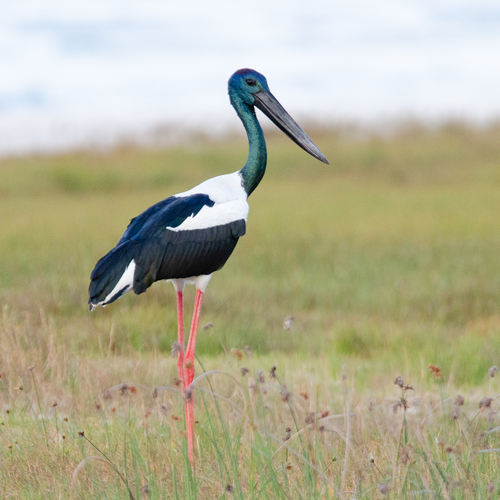
Black-necked Stork
Ephippiorhynchus asiaticus
With its towering height, striking red legs, and iridescent plumage, the Black-necked Stork is one of the most majestic sentinels of the tropical wetlands. Often called the 'Jabiru' in Australia, this formidable hunter is a master of the shallow marshes.
Quick Identification
Size
Height 129–150 cm (51–59 in); Wingspan 230 cm (91 in); Weight 4 kg (8.8 lbs)
Colors
White body with iridescent black (reflecting green/purple) on the neck, head, wing bands, and tail. Massive black bill and bright red legs. Females have bright yellow eyes, while males have dark brown to black eyes.
Key Features
- Massive black wedge-shaped bill
- Iridescent green-black neck and head
- Long, bright red legs
- Striking white and black wing pattern
- Female has yellow eyes, male has dark eyes
When You’ll See Them
Geographic range
Where Does the Black-necked Stork Live?
Native to the tropical and subtropical regions of Asia and Oceania, the Black-necked Stork occupies a broad but fragmented range. In Asia, its core populations are found across the Indian subcontinent—including India, Sri Lanka, and Nepal—and extend through parts of Southeast Asia like Myanmar and Cambodia. A distinct and significant population thrives across the northern and eastern coastal regions of Australia, where it is often the only stork species encountered by locals.
Basemap © OpenStreetMap contributors
Behavior
The Black-necked Stork is a solitary and highly territorial bird, often seen patrolling its wetland domain with a slow, deliberate gait. Unlike many other stork species that are social and colonial, these birds are fiercely protective of their feeding and nesting areas, often driving away competitors or even their own grown offspring. They are silent, patient hunters, using their sharp vision to detect movement in the water before striking with lightning speed.
In courtship, they perform elaborate displays involving wing-spreading and bill-clattering, though they are generally quiet birds. While they are wary of human presence, they have successfully adapted to living near agricultural landscapes like rice paddies in parts of Asia. They are monogamous and build massive stick nests high in trees, which they may reuse for several seasons, adding new material each year.
EverydayEarth exclusive
Camera Tips
Capturing the Black-necked Stork on camera requires patience and strategic placement, as they are cautious birds with excellent eyesight. For the best results, place your camera near the edge of a shallow wetland or a persistent puddle in an agricultural field. Set the camera on a tripod or a low stake about 2 to 3 feet off the ground, angled slightly upward to capture their impressive height and massive bill without cutting off their long red legs.
Avoid using traditional food baits, as these birds prefer live, moving prey; instead, focus on 'bottleneck' locations where water levels are dropping, as these areas naturally concentrate fish and frogs, making them irresistible to the stork. Because they are most active during the cooler morning and late afternoon hours, ensure your camera's trigger speed is set to its fastest setting to catch the sudden, rapid strike movement when they hunt.
Since these birds are territorial, once you find a spot they frequent, they are likely to return daily. Use a high-resolution setting or 4K video if available, as the iridescent plumage on their neck is a highlight that only shows up well in clear, bright light. Ensure your camera is well-camouflaged with local vegetation or a drab housing, as any shiny or metallic surfaces may spook this wary giant.
Similar Species
Species that look similar or are commonly confused with Black-necked Stork.
White-necked Heron
Smaller with a much thinner, grey bill and lacks the iridescent black neck and red legs.
Lesser Adjutant
Lacks the clean white and black patterning, often appearing scruffier with a bald-looking head and neck.
Saddle-billed Stork
Found in Africa; similar in size but features a colorful red, yellow, and black bill.
Frequently Asked Questions
Record Black-necked Stork at your habitat
Connect a camera to start building your own species record — AI identifies every visitor automatically.