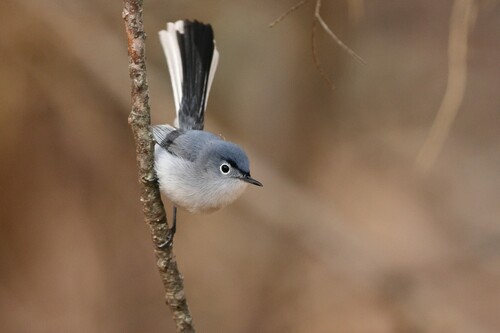
Blue-gray Gnatcatcher
Polioptila caerulea
Hyperactive and bold, the Blue-gray Gnatcatcher is a master of the canopy, known for its constant tail-flicking and its expertly camouflaged lichen nests.
Quick Identification
Size
Length: 10–13 cm (4–5 in); Wingspan: 16 cm (6.3 in); Weight: 5–7 g (0.2 oz)
Colors
Pale blue-gray upperparts with white underparts. Males feature a prominent black 'V' on the forehead during the breeding season. The long black tail is edged with white outer feathers.
Key Features
- Constant side-to-side tail flicking
- Distinct white eye ring
- Tiny, slender build with a long, thin tail
- Needle-like black bill
When You’ll See Them
Geographic range
Where Does the Blue-gray Gnatcatcher Live?
Native to the North American continent, the Blue-gray Gnatcatcher occupies a vast territory spanning from the southern edges of Canada throughout the United States and into Mexico. While they are common summer residents in the eastern and southwestern U.S., they are migratory birds that retreat to the southern tip of Florida, the Caribbean, and Central America during the winter months. This species is one of the earliest migratory songbirds to return north in the spring, often arriving well before the leaves have fully unfurled on the trees.
Basemap © OpenStreetMap contributors
Behavior
The Blue-gray Gnatcatcher is a bird in perpetual motion. These tiny insectivores are famous for their hyperactive foraging style, constantly flitting through the leaves of deciduous trees and shrubs. They exhibit a unique behavior called 'flushing,' where they rhythmically wag and flick their long, white-edged tails to startle insects into movement, making them easier to catch. Despite their small size, they are remarkably vocal, though their thin, wheezy songs and 'pwee' calls often go unnoticed by the casual observer.
Socially, they are highly territorial during the breeding season. They are known for their architectural prowess, weaving exquisite, cup-shaped nests out of spiderwebs and plant down, then camouflaging the exterior with bits of lichen to make the nest look like a natural knot on a tree branch. While they generally ignore humans, they are bold enough to dive-bomb much larger birds or even squirrels that venture too close to their nesting sites.
EverydayEarth exclusive
Camera Tips
Capturing the Blue-gray Gnatcatcher on a backyard camera requires a specialized setup because they rarely spend time on the ground. To increase your chances of a sighting, mount your camera at chest height or higher, focusing on a water feature. Unlike many birds that prefer deep baths, gnatcatchers are attracted to moving water. Using a mister or a small solar-powered fountain in a shallow basin is the single best way to lure them into your camera's field of view.
Because these birds are incredibly fast and small, standard trail camera settings often result in 'ghost' images or empty frames. You should use a camera with a high-speed trigger (0.2 seconds or faster) and set it to 'Photo Burst' mode. Capturing 3 to 5 images per trigger event is essential to ensure at least one shot catches the bird mid-flick. If you are using video mode, set your resolution to 4K at 60fps; the high frame rate is necessary to see their rapid movements without blurring.
Positioning is also key for these pale-colored birds. To avoid overexposed shots where the bird looks like a white blur, place your camera with the sun at its back, preferably in a spot with dappled shade. Look for 'edge' habitats in your yard—the transition zone between a wooded area and a clearing—as this is where they most frequently forage. During late spring, keep an eye out for their lichen-covered nests on horizontal branches; placing a camera 15-20 feet away from a nest can capture amazing footage of their constant activity as they feed their young.
Similar Species
Species that look similar or are commonly confused with Blue-gray Gnatcatcher.
Tufted Titmouse
Larger with a prominent head crest and peach-colored sides; lacks the Gnatcatcher's long, white-edged tail.
Black-capped Chickadee
Features a distinct black cap and bib, whereas the Gnatcatcher is uniformly blue-gray on top with a white eye ring.
Ruby-crowned Kinglet
Slightly rounder with olive-toned feathers and lacks the Gnatcatcher's long, constantly flicking black-and-white tail.
Frequently Asked Questions
Record Blue-gray Gnatcatcher at your habitat
Connect a camera to start building your own species record — AI identifies every visitor automatically.