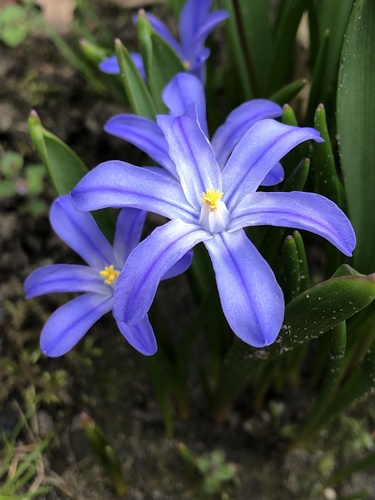
Boissier's Glory-of-the-snow
Scilla luciliae
A vibrant herald of the changing seasons, Boissier's Glory-of-the-snow blankets the early spring landscape in a sea of violet-blue. These hardy Turkish natives are famous for their ability to bloom while snow still dusts the ground, offering a vital first taste of nectar for waking pollinators.
Quick Identification
Size
Stands 10–15 cm (4–6 inches) tall with flowers approximately 2.5 cm (1 inch) in diameter.
Colors
Brilliant violet-blue petals with a starkly contrasting white center; foliage is a deep, waxy green.
Key Features
- Upward-facing star-shaped flowers
- Distinctive white 'eye' at the center of the bloom
- Two to three narrow, strap-shaped basal leaves
- Flowers appear in very early spring, often through snow
When You’ll See Them
Geographic range
Where Does the Boissier's Glory-of-the-snow Live?
Originally native to the high-altitude mountains of western Turkey, specifically the Boz Dağ range, Boissier's Glory-of-the-snow has traveled far beyond its Mediterranean roots. It is now widely naturalized across temperate Europe and North America, thriving in USDA zones 3 through 8. In these regions, it has successfully jumped the garden fence, finding a home in suburban parks, old estates, and deciduous forest edges where it blooms alongside native wildflowers.
Basemap © OpenStreetMap contributors
Behavior
These plants are quite social in their growth habit, frequently forming large, dense colonies that look like a fallen piece of the sky on the garden floor. They spread both through bulb offsets and by self-seeding. Interestingly, their seeds have a small fatty attachment called an elaiosome, which attracts ants. The ants carry the seeds to their nests, effectively acting as tiny gardeners that plant the seeds in new locations.
EverydayEarth exclusive
Camera Tips
Lighting is the most critical factor for these flowers. They are 'nyctinastic,' meaning they close up at night and on very cloudy days to protect their reproductive organs. For the best photos, set your camera to trigger during the mid-morning hours when the sun is high enough to encourage the blooms to open fully but not so high that it creates harsh, blown-out highlights on the white centers. The vibrant blue color is a natural lure for the camera's sensor, but the contrast can be tricky; early morning 'golden hour' light often brings out the richest violet tones.
If your camera supports time-lapse mode, this is one of the best species to document. A time-lapse over a 48-hour period can show the dramatic way the flowers follow the sun and close up tightly as the temperature drops in the evening. Furthermore, because they are such early bloomers, your camera is likely to capture some of the first pollinators of the year. Position the camera near a large cluster to increase your chances of filming queen bumblebees or hoverflies as they visit the flowers for a much-needed early-season sugar boost. No artificial lures are needed, as the flowers' color and nectar are the primary attractants.
Similar Species
Species that look similar or are commonly confused with Boissier's Glory-of-the-snow.
Siberian Squill
Features drooping, bell-like flowers that face downward and lacks the white central eye.
Forbes' Glory-of-the-snow
Very similar but typically grows taller and produces more flowers (up to 12) on a single stem.
Common Snowdrop
Blooms at the same time but has nodding white flowers with green markings rather than blue star-shaped blooms.
Frequently Asked Questions
Record Boissier's Glory-of-the-snow at your habitat
Connect a camera to start building your own species record — AI identifies every visitor automatically.