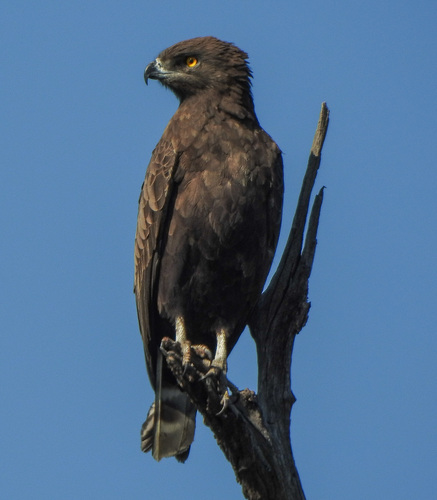
Brown Snake-Eagle
Circaetus cinereus
The stoic sentinel of the African savanna, the Brown Snake-Eagle is a master of patience. With its piercing yellow gaze and chocolate-brown plumage, this solitary raptor is one of nature's most effective snake hunters.
Quick Identification
Size
Length: 68-75 cm (27-30 in); Wingspan: 154-164 cm (60-65 in); Weight: 1.5-2.5 kg (3.3-5.5 lbs)
Colors
Uniform dark chocolate brown plumage; bright yellow irises; pale grey, unfeathered legs; silvery-grey flight feathers visible from below.
Key Features
- Large rounded head with piercing yellow eyes
- Solid dark brown body with no crest
- Bare, pale greyish-white legs
- Silvery-white wing linings visible in flight
When You’ll See Them
Geographic range
Where Does the Brown Snake-Eagle Live?
This powerful raptor is native to the African continent, where it maintains a massive range across sub-Saharan Africa. It is most commonly found in the broad savanna belts of East and Southern Africa, spanning from Ethiopia and Kenya down to South Africa, while also appearing in the wooded regions of West Africa from Senegal to Nigeria. Though widespread, it is rarely concentrated in high numbers, preferring to live at low densities across its vast territory.
Basemap © OpenStreetMap contributors
Behavior
The Brown Snake-Eagle is the quintessential 'sit-and-wait' predator. Unlike many eagles that spend hours soaring on thermals, this species prefers to spend the majority of its day perched motionless on high vantage points. From a prominent dead tree or utility pole, it uses its immense, specialized eyes to scan the ground for the slightest movement of a snake. When prey is spotted, it descends in a controlled glide to pin the snake to the ground with its powerful, rough-scaled feet.
This eagle is famously solitary and is rarely seen in groups or even pairs outside of the early stages of the breeding season. They are remarkably bold when confronted with dangerous prey, often engaging in life-or-death struggles with highly venomous snakes. Despite their predatory prowess, they are generally shy around humans and will fly off long before a person gets close, making them a challenging but rewarding subject for remote camera observation.
EverydayEarth exclusive
Camera Tips
Capturing a Brown Snake-Eagle on camera requires focusing on 'sentinel' locations rather than ground-level baiting. Because they are high-perch hunters, look for isolated, prominent dead trees or 'stags' that overlook open savanna or grassy clearings. Mount your camera on a nearby tree at a slight upward angle, or use a high-quality cellular camera mounted directly to the lower trunk of the perch tree (facing outward) to catch the bird as it lands or takes off.
Since these eagles hunt reptiles, they are most active during the warmest parts of the day when snakes are out basking. Set your camera to a high-speed burst mode (3-5 photos per trigger) with a fast shutter speed to capture the action of a landing. These birds are large and heavy, so they create a significant heat signature that easily triggers most PIR sensors even from a distance of 15-20 feet.
Avoid trying to lure them with food; instead, capitalize on their habit of using the same perch daily. If you find a tree with white 'mute' (bird droppings) at the base or shed snake skins nearby, you have found a goldmine. Ensure your camera is well-camouflaged with natural bark or leaves, as their eyesight is incredibly sharp and they may avoid a perch if they notice a strange, reflective object like a camera lens.
Similar Species
Species that look similar or are commonly confused with Brown Snake-Eagle.
Black-chested Snake-Eagle
Has a stark white belly and underwings, whereas the Brown Snake-Eagle is dark brown all over.
Martial Eagle
Much larger with a spotted white belly and a small crest on the back of the head.
Western Banded Snake-Eagle
Smaller, prefers riverine forests, and has horizontal grey barring on its belly.
Frequently Asked Questions
Record Brown Snake-Eagle at your habitat
Connect a camera to start building your own species record — AI identifies every visitor automatically.