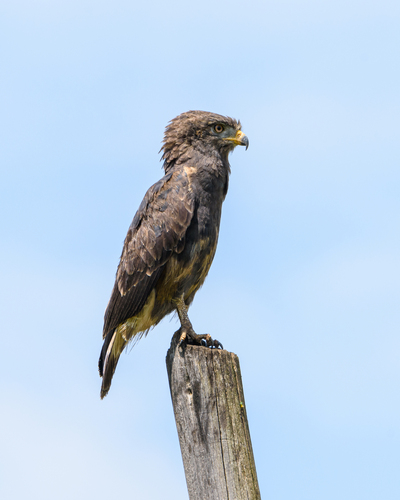
Western Banded Snake-Eagle
Circaetus cinerascens
The silent guardian of Africa's waterways, the Western Banded Snake-Eagle is a master of camouflage and precision. Known for its striking yellow eyes and specialized hunting skills, it is one of the most elusive and rewarding raptors to capture on a trail camera.
Quick Identification
Size
Length: 50-60 cm (20-24 in); Wingspan: 114-135 cm (45-53 in); Weight: 0.9-1.2 kg (2.0-2.6 lbs)
Colors
Adults are mostly gray-brown with fine white horizontal barring (banding) on the belly and thighs. They feature bright yellow eyes, a yellow cere, and yellow legs. Juveniles are paler with white-edged feathers.
Key Features
- Large rounded head with a short, bushy crest
- Single broad white band across a short dark tail
- Bright yellow eyes and unfeathered legs
- Finely banded white and brown underparts on adults
When You’ll See Them
Geographic range
Where Does the Western Banded Snake-Eagle Live?
Native to the African continent, the Western Banded Snake-Eagle occupies a wide range across Sub-Saharan Africa. It is found in a broad belt from Senegal and Gambia in the west, stretching through the Central African Republic to Ethiopia in the east, and reaching as far south as northern Namibia, Botswana, and Zimbabwe. It is particularly common along the corridors of major rivers like the Zambezi and Okavango.
Basemap © OpenStreetMap contributors
Behavior
While generally solitary and quiet, they are most vocal during the breeding season. Their call is a loud, rhythmic series of high-pitched notes that carry across riverine forests. They are highly territorial and non-migratory, often staying within the same river system for their entire lives. They tend to avoid human settlements unless there is significant tree cover and a healthy population of reptiles available.
EverydayEarth exclusive
Camera Tips
Since these eagles are primarily motivated by movement, you don't necessarily need bait. Instead, focus your camera on areas where reptiles are active. A sunny log near water where lizards bask or a clear path used by snakes is a natural 'magnet' for this eagle. Setting your camera to 'Burst Mode' or high-speed video is essential; these birds strike with incredible speed, and a single still shot often misses the most dramatic action of the hunt.
Lighting is your best friend and worst enemy. Because they often perch in deep shade to stay cool, ensure your camera has a high dynamic range (HDR) setting or adjust the exposure to compensate for dark backgrounds. The best time for footage is mid-morning when the sun is high enough to illuminate the understory but not so hot that the birds retreat into the deep, dark interior of the forest. If you are in a backyard setting near a river, planting indigenous trees that provide high canopy cover will increase your chances of a visit.
Similar Species
Species that look similar or are commonly confused with Western Banded Snake-Eagle.
Beaudouin's Snake-Eagle
Beaudouin's is much larger and has finely barred underparts that extend all the way up to the throat, unlike the Western Banded which has a solid brown chest.
Brown Snake-Eagle
The Brown Snake-Eagle is significantly larger, has an all-brown belly without bands, and lacks the prominent white tail band.
Southern Banded Snake-Eagle
Very similar, but the Southern variety has more white bands on the tail (2-3) compared to the single band of the Western.
Frequently Asked Questions
Record Western Banded Snake-Eagle at your habitat
Connect a camera to start building your own species record — AI identifies every visitor automatically.