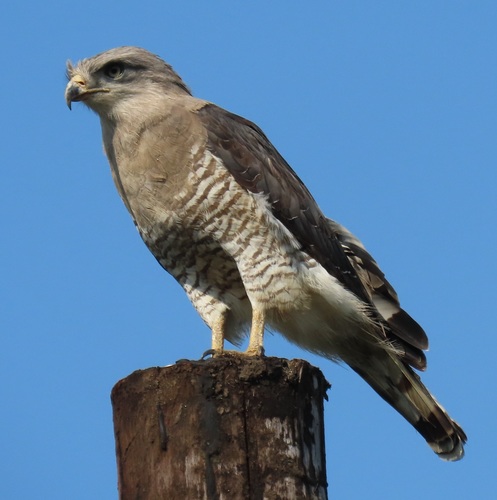
Southern Banded Snake Eagle
Circaetus fasciolatus
A master of camouflage in the coastal canopy, the Southern Banded Snake Eagle is one of Africa's most secretive raptors. Known for its piercing yellow eyes and striking barred plumage, it is a prized discovery for any backyard naturalist in its coastal range.
Quick Identification
Size
Length: 54-60 cm (21-24 in); Wingspan: 110-120 cm (43-47 in); Weight: 900-1,100 g (2.0-2.4 lbs)
Colors
Dark brown upperparts; white underparts with fine brown horizontal barring (bands); yellow iris, cere, and legs.
Key Features
- Distinctive brown-and-white barred underparts
- Bright yellow eyes and facial skin (cere)
- Three dark bands on a relatively short tail
- Broad, rounded wings visible in flight
When You’ll See Them
Geographic range
Where Does the Southern Banded Snake Eagle Live?
This elusive raptor is native to the eastern coast of the African continent. Its core range stretches from southern Somalia and coastal Kenya, through the lush tropical forests of Tanzania and Mozambique, reaching its southern limit in the KwaZulu-Natal province of South Africa. Because it is highly dependent on intact coastal forest corridors, its distribution is naturally fragmented and restricted to these specific evergreen environments.
Basemap © OpenStreetMap contributors
Behavior
During the breeding season, it becomes much more vocal and conspicuous, performing undulating aerial displays and emitting high-pitched, rhythmic calls to establish territory. Despite its predatory nature, it is generally shy and wary of human presence, making it a 'specialty' sighting that requires quiet observation and a keen eye for detail in its specific coastal niche.
EverydayEarth exclusive
Camera Tips
Since they are snake specialists, they are frequently attracted to sun-drenched patches in the forest undergrowth where reptiles bask. If you have a property with natural forest edges, placing a camera near a known reptile hotspot during the mid-morning hours (when snakes are active) significantly increases your chances of seeing the eagle swoop down for a strike. Avoid using artificial lures; instead, focus on maintaining a natural, quiet environment that encourages their preferred prey to thrive.
Set your AI camera to 'Bird' or 'Large Motion' mode with the highest possible trigger speed. Because these eagles often sit perfectly still for long periods, a 'Time-Lapse' mode set to take a photo every 5-10 minutes can be a game-changer. This often captures them while they are perched and camouflaged—moments that motion sensors might miss. Ensure you use a high-resolution setting to capture the fine detail of their barred plumage, which is essential for distinguishing them from other forest raptors.
Similar Species
Species that look similar or are commonly confused with Southern Banded Snake Eagle.
Western Banded Snake Eagle
Found in more open riverine habitats further west; has a single prominent white tail band instead of multiple thin ones.
Brown Snake Eagle
Much larger and lack the white barred underparts; prefers more open savanna and woodland.
African Cuckoo-Hawk
Smaller with a different wing shape in flight and a small crest on the back of the head.
Frequently Asked Questions
Record Southern Banded Snake Eagle at your habitat
Connect a camera to start building your own species record — AI identifies every visitor automatically.