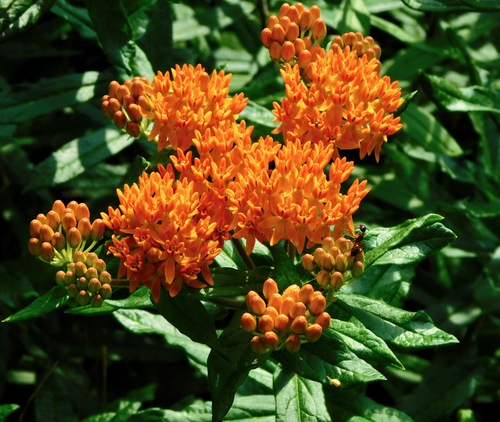
butterfly milkweed
Asclepias tuberosa
The vibrant orange crown of the prairie, butterfly milkweed is a must-have for any pollinator garden and a favorite of monarch butterflies.
Quick Identification
Size
Height: 12-30 inches (30-76 cm); Spread: 12-18 inches (30-45 cm)
Colors
Brilliant orange to yellow-orange flower clusters; dark green lance-shaped leaves; hairy green stems
Key Features
- Clustered star-shaped orange flowers
- Clear sap instead of milky latex
- Hairy, alternate leaves along the stem
- Deep woody taproot
When You’ll See Them
Geographic range
Where Does the butterfly milkweed Live?
Native to the vast landscapes of North America, butterfly milkweed thrives across a wide geographic footprint. From the sun-drenched prairies of the Midwestern United States and the sandy pine barrens of the East Coast to the rocky slopes of the Southwest and southern regions of Canada, this resilient perennial is a staple of the continent's temperate zones. It is particularly prevalent in the Great Plains and the Appalachian region, where it has adapted to various soil types and moisture levels.
Basemap © OpenStreetMap contributors
Behavior
Butterfly milkweed is a hardy perennial that acts as a cornerstone for local ecosystems. Unlike its cousins in the milkweed family, it does not produce a milky sap when broken, yet it remains a critical host plant for the monarch butterfly. It emerges later in the spring than many other garden plants, often leading gardeners to believe it has not survived the winter, but it grows rapidly once the soil warms up.
As a nectar powerhouse, it exhibits a 'social' interaction with the insect world, often being crowded with multiple species of butterflies, bees, and wasps simultaneously. It is highly drought-tolerant once established due to its deep taproot, making it a low-maintenance favorite for wildlife-friendly landscaping. In the late summer, it produces attractive spindle-shaped seed pods that split to release silky, wind-blown seeds.
EverydayEarth exclusive
Camera Tips
To capture the stunning beauty of butterfly milkweed and its frequent visitors, position your camera at flower height, typically 18 to 24 inches above the ground. Using a tripod is highly recommended to maintain a steady frame, as the vibrant orange of the blooms provides a perfect high-contrast subject for AI-powered motion detection. If your camera has a macro setting or a close-focus lens, use it to highlight the intricate 'horns' and 'hoods' that make up the individual star-shaped flowers.
The real magic happens when you capture the interactions between the plant and pollinators. Set your camera’s shutter speed to a high setting (1/1000s or faster) to freeze the motion of butterfly wings. For the best lighting, aim to shoot during the 'golden hours'—shortly after sunrise or before sunset. The low-angle sunlight makes the orange petals glow without the harsh, washing effect of the midday sun. If you are using a trail camera, ensure it is positioned with the sun at the camera's back to avoid lens flare.
Since butterfly milkweed is a perennial, it provides a predictable stage for wildlife photography year after year. Consider setting up a time-lapse over several days in mid-summer. This allows you to document the dramatic opening of the flower umbels or the fascinating growth stages of monarch caterpillars as they strip the leaves. Ensure your camera is set to a high sensitivity for motion, as the light landing of a butterfly may not trigger standard PIR sensors; pixel-based motion detection is often more effective for these smaller visitors.
Similar Species
Species that look similar or are commonly confused with butterfly milkweed.
Common Milkweed
Features pink flowers, larger oval leaves, and milky white sap when broken.
Swamp Milkweed
Prefers wet soil and has pink to mauve flowers; it also contains milky sap.
Tropical Milkweed
Usually has bi-colored red and yellow flowers and does not die back to the ground in frost-free zones.
Frequently Asked Questions
Record butterfly milkweed at your habitat
Connect a camera to start building your own species record — AI identifies every visitor automatically.