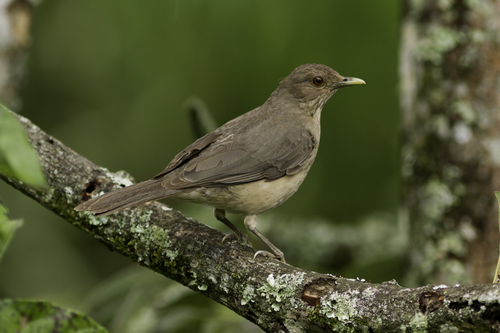
Clay-colored Thrush
Turdus grayi
Meet the Clay-colored Thrush, the melodious national bird of Costa Rica celebrated for its 'rain-calling' song. A master of suburban adaptation, this sandy-brown songbird is a frequent and friendly visitor to backyards across the Americas.
Quick Identification
Size
23–27 cm (9–10.6 in) long; wingspan 34–38 cm (13.5–15 in); weight 74–76 g (2.6–2.7 oz)
Colors
Uniform sandy-brown or clay-colored plumage; paler cinnamon-buff underparts; greenish-yellow bill; streaked throat
Key Features
- Uniform sandy-brown plumage without breast spots
- Greenish-yellow bill with a slightly darker base
- Pale buff-colored underwings visible in flight
- Finely streaked throat and pale eye-ring
When You’ll See Them
Sightings on EverydayEarth
Mar 17, 2026
A Whooping Motmot perches prominently on the fruit feeder platform, displaying its vibrant rufous and green plumage and black facial mask. To its right, a Social Flycatcher sits on the edge of the platform. Shortly after, a Clay-colored Thrush flies in and lands on a branch near the red hummingbird feeder. The birds are actively foraging and observing their tropical surroundings.
Jul 30, 2026
A group of tropical birds gathers at the fruit feeder in the morning light. A Clay-colored Thrush is the most prominent visitor, hopping onto the tray to eat from the sliced fruit. It is eventually joined by several Blue-gray Tanagers that land on the edges of the platform. In the background, a tiny Bananaquit visits the red hummingbird feeder before flitting down toward the main feeding area.
Jul 29, 2026
A Clay-colored Thrush is perched on the right side of a feeder platform laden with sliced fruit. It hops among the fruit pieces, occasionally pausing to look around the dense tropical foliage before resuming its foraging.
Jul 28, 2026
A variety of tropical birds, including Blue-gray Tanagers, a Bananaquit, and a Palm Tanager, are seen feeding on an assortment of fruit at the platform. A Clay-colored Thrush remains stationary on a nearby branch. The peaceful feeding session is interrupted when a Red-tailed Squirrel suddenly vaults onto the tray from below, causing the birds to quickly take flight as the squirrel begins to inspect the fruit.
Jul 28, 2026
Two Clay-colored Thrushes are active on the feeder platform. One bird is already present at the start, pecking at a piece of fruit, while a second individual hops up to join it, moving between the orange and papaya slices.
Jul 28, 2026
A Clay-colored Thrush stands on the wooden feeder tray, methodically pecking at slices of papaya and orange among the lush tropical vegetation.
Geographic range
Where Does the Clay-colored Thrush Live?
Native to the Americas, the Clay-colored Thrush occupies a vast range stretching from the southern tip of Texas in the United States down through eastern Mexico and across every country in Central America. Its southern limit reaches into northern South America, including parts of Colombia and Venezuela. While it was once considered a rare visitor to the U.S., it has established a permanent breeding population in the Rio Grande Valley and continues to expand its presence northward.
Basemap © OpenStreetMap contributors
Recorded on EverydayEarth
Behavior
The Clay-colored Thrush is perhaps best known for its beautiful, flute-like song, which is remarkably similar to that of its cousin, the American Robin. In Central America, particularly Costa Rica, it is famously known as the 'yigüirro' and is celebrated for 'calling the rain' at the start of the wet season. These birds are highly comfortable in human environments, often hopping across suburban lawns with a distinctive stop-and-start movement as they hunt for prey.
They are generally social birds, frequently seen in pairs or small family groups, though they can become quite territorial of their nesting sites during the spring. They are intelligent foragers, often following army ant swarms to catch insects flushed out by the ants. In backyard settings, they are bold and curious, often nesting on building ledges or in thick ornamental shrubbery close to human activity.
EverydayEarth exclusive
Camera Tips
To capture high-quality footage of a Clay-colored Thrush, low-profile camera placement is essential. These birds spend the majority of their time on the ground searching for food, so mount your AI-powered camera roughly 12 to 18 inches above the soil. Aim the lens toward an open patch of lawn or a mulched garden bed where the soil is moist, as this is where they are most likely to hunt for worms and insects.
Water is the ultimate lure for this species. A shallow birdbath or a trickling water feature is nearly irresistible to them. Positioning your camera to face a water source will not only capture frequent drinking and bathing behavior but also provide excellent opportunities to record their melodious vocalizations. Ensure the camera is positioned to avoid direct midday sun flare, as their uniform clay-colored plumage can easily wash out in harsh light.
For food-based lures, use a platform feeder stocked with halved bananas, overripe papaya, or orange slices. Unlike some other thrushes that prefer hidden spots, Clay-colored Thrushes are quite bold and will readily visit open feeders. Set your camera's motion sensitivity to a high level, as their earthy tones can sometimes blend into the background shadows. During the breeding season (March to June), keep an eye out for birds carrying mud and dry grass, which indicates a nest is nearby.
Similar Species
Species that look similar or are commonly confused with Clay-colored Thrush.
American Robin
The American Robin has a distinctive red-orange breast and a darker, almost blackish head, whereas the Clay-colored Thrush is uniformly brownish-buff.
Wood Thrush
The Wood Thrush features bold, dark spots on its white breast, while the Clay-colored Thrush has a plain, unspotted breast.
Tropical Mockingbird
The mockingbird is gray and white with a much longer tail and white wing bars, unlike the stocky, all-brown thrush.
Frequently Asked Questions
Record Clay-colored Thrush at your habitat
Connect a camera to start building your own species record — AI identifies every visitor automatically.