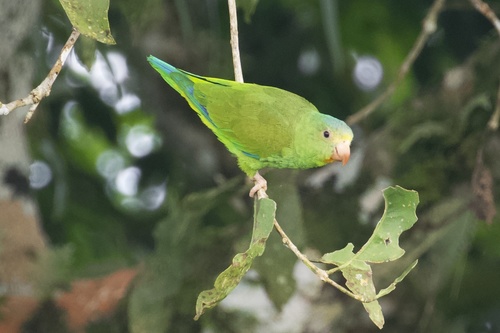
Cobalt-winged Parakeet
Brotogeris cyanoptera
Witness the flash of celestial blue against the deep Amazonian green. The Cobalt-winged Parakeet is a social, high-energy icon of the South American canopy.
Quick Identification
Size
Length: 18-20 cm (7-8 in); Weight: 50-67 g (1.8-2.4 oz)
Colors
Primarily emerald green body; striking cobalt-blue primary and secondary wing coverts; yellowish-orange chin patch and forehead; horn-colored beak.
Key Features
- Distinctive cobalt-blue patches on wings visible in flight
- Small, wedge-shaped tail
- Yellowish-orange chin spot
- Bright emerald green plumage with paler underparts
When You’ll See Them
Geographic range
Where Does the Cobalt-winged Parakeet Live?
Native to the South American continent, the Cobalt-winged Parakeet is a quintessential resident of the vast Amazon Basin. Its primary range covers the tropical lowlands of Brazil, Peru, and Colombia, while also extending into the forested regions of Bolivia, Ecuador, Venezuela, and Guyana. This species is firmly established as a resident across this territory, following the lush river systems and primary forest belts where food is abundant year-round.
Basemap © OpenStreetMap contributors
Behavior
Cobalt-winged Parakeets are highly social and energetic birds that are almost always seen in pairs or noisy flocks. They are famous for their high-pitched, screeching calls which they frequently emit while in flight or when feeding in the canopy. These social structures are vital for protection and foraging, as they work together to locate seasonal fruit crops across the vast Amazonian landscape.
In the wild, they spend the majority of their time in the upper layers of the forest, only descending to lower levels or the ground to visit clay licks (saladeros) or to drink water. Their flight is fast and direct, and their green plumage provides excellent camouflage against the leaves until they take flight, revealing their namesake blue wing feathers. While generally shy around humans in remote areas, they can become habituated to rural settlements near forest edges where fruiting trees are maintained.
EverydayEarth exclusive
Camera Tips
To capture high-quality footage of Cobalt-winged Parakeets, elevation is your biggest challenge. These birds are arboreal and rarely descend to the forest floor. For the best results, mount your AI-powered camera at least 10 to 15 feet high on a sturdy branch or trunk. Focus on 'hotspots' such as fruiting fig trees or flowering palms, as these are the primary draws for local flocks. Angle the camera slightly downward to capture the bird's back and wings, which will help the AI identify the distinctive cobalt plumage.
If you are in a rural or forest-edge area, you can attract them using a high-platform bird bath or a hanging fruit feeder. Fresh papaya, mango, or halved oranges are excellent lures. However, be patient; parakeets are naturally wary of new objects. Place your camera near the feeder several days before activating it to allow the birds to become comfortable with its presence. Early morning is the best time for recording, as this is when the birds are most vocal and active in their search for breakfast.
Because these parakeets move with sudden, jerky motions, set your camera to a fast shutter speed or high-frame-rate video mode. This prevents the 'green blur' effect when they startle or engage in social squabbles. If your camera has a burst photo mode, use it; parakeets are rarely still, and a series of rapid shots increases your chances of catching that perfect moment when the cobalt wing feathers are fully fanned out.
Lighting in the tropical canopy can be tricky due to high contrast. Try to position your camera with the sun at its back to avoid silhouetting the birds. If the canopy is particularly dense and dark, ensure your camera's ISO settings are optimized for low-light conditions without introducing too much grain, as the fine details of their feathers are essential for a beautiful species profile.
Similar Species
Species that look similar or are commonly confused with Cobalt-winged Parakeet.
Tui Parakeet
Lacks the blue wing feathers and has a much more prominent, solid yellow forehead patch.
Orange-chinned Parakeet
Has a similar orange chin but features bronze-brown wing coverts instead of cobalt blue.
White-winged Parakeet
Easily distinguished by the large white patches on the wings instead of blue.
Frequently Asked Questions
Record Cobalt-winged Parakeet at your habitat
Connect a camera to start building your own species record — AI identifies every visitor automatically.