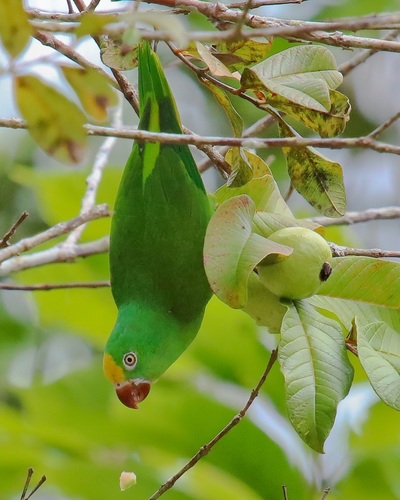
Tui Parakeet
Brotogeris sanctithomae
A social and spirited resident of the Amazon, the Tui Parakeet is instantly recognizable by the sun-yellow patch on its forehead. These acrobatic green parrots bring life and noise to gardens and riverbanks across South America.
Quick Identification
Size
17–18 cm (6.5–7 inches) in length; weight ranges from 55–65 g (1.9–2.3 oz)
Colors
Primary plumage is a vibrant grass-green; distinctive bright yellow patch on the forehead; pale horn-colored or flesh-toned bill; yellowish-green underparts.
Key Features
- Distinctive bright yellow forehead patch
- Small, stocky build with a short, pointed tail
- Pale, flesh-colored beak
- Narrow pale-grey eye-ring
When You’ll See Them
Geographic range
Where Does the Tui Parakeet Live?
Native to the lush tropical heart of South America, the Tui Parakeet is a specialist of the Amazon Basin. Its core range spans northern Bolivia, western and central Brazil, eastern Peru, and southeastern Colombia, with occasional populations appearing in eastern Ecuador. It is most frequently encountered along major river corridors and in the low-lying seasonally flooded forests that characterize this vast tropical region.
Basemap © OpenStreetMap contributors
Behavior
Tui Parakeets are exceptionally social birds, almost always found in pairs or loud, energetic flocks that can range from a dozen to several hundred individuals. They are known for their high-pitched, metallic chattering calls which they maintain even while flying. They are highly acrobatic foragers, often seen hanging upside down from thin branches to reach ripening fruit or blossoms.
While they are naturally forest-dwellers, they have adapted remarkably well to human presence, often visiting suburban gardens and orchards near the Amazon's edge. They are not particularly shy and can be quite bold when a reliable food source is discovered, frequently returning to the same trees day after day. Their social structure is tight-knit, and they often engage in allopreening (mutual grooming) during the heat of the day.
EverydayEarth exclusive
Camera Tips
To capture the Tui Parakeet on camera, placement is everything. These birds are canopy-dwellers but will descend to lower levels for food and water. Mount your camera 5 to 8 feet off the ground, ideally facing a fruiting tree like a guava or a palm, or near a specialized nectar feeder. Because they move quickly and in groups, use a camera with a high-speed trigger and a 'burst' or 'photo gallery' mode to ensure you catch the action rather than just a blur of green feathers.
Lighting is a major factor in the deep forest or garden shadows where these parakeets forage. Position your camera facing north or south to avoid direct sun flare, which can wash out the brilliant yellow on their foreheads. If your camera has adjustable ISO settings, a slightly higher sensitivity can help capture crisp images in the dappled light of a garden canopy. Early morning, just after sunrise, is the golden hour for Tui Parakeet activity as they leave their roosts in search of breakfast.
If you are trying to attract them to a specific spot for your camera, consider a birdbath or a shallow water feature. Tui Parakeets are frequent drinkers and bathers, especially during the drier months. A dripping water sound or a small solar-powered fountain can act as a powerful lure. Ensure the camera angle captures the water's surface from a slight distance to account for the parakeets' habit of landing on nearby branches first to scout for safety before hopping down to drink.
Similar Species
Species that look similar or are commonly confused with Tui Parakeet.
Yellow-chevroned Parakeet
Lacks the yellow forehead of the Tui and features prominent yellow markings on the wing coverts.
Cobalt-winged Parakeet
Features bright blue flight feathers and lacks the yellow forehead patch entirely.
Orange-chinned Parakeet
Has a small orange patch under the beak rather than a yellow patch on the forehead.
Frequently Asked Questions
Record Tui Parakeet at your habitat
Connect a camera to start building your own species record — AI identifies every visitor automatically.