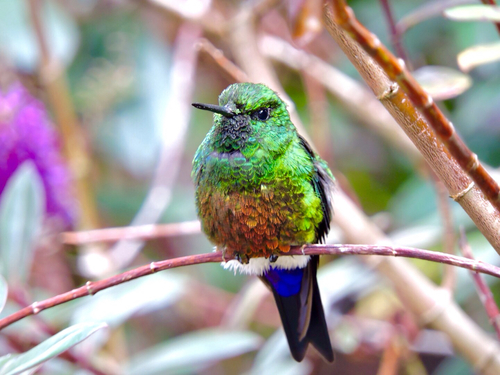
Coppery-bellied Puffleg
Eriocnemis cupreoventris
A high-altitude gem of the Andes, the Coppery-bellied Puffleg dazzles with its metallic orange belly and whimsical white leg tufts. This resilient hummingbird is a master of the misty cloud forests of Colombia and Venezuela.
Quick Identification
Size
9–10 cm (3.5–4 in) in length; weight approximately 4.2–5.5 g (0.15–0.19 oz)
Colors
Shining green upperparts, brilliant coppery-orange to reddish-gold belly (males), white leg 'puffs', and blue-green undertail coverts. Females have white-mottled underparts.
Key Features
- Distinctive white downy 'puffs' on the legs
- Vibrant coppery-orange patch on the lower belly
- Straight, medium-length black bill
- Deeply forked, blue-black tail
When You’ll See Them
Geographic range
Where Does the Coppery-bellied Puffleg Live?
This stunning hummingbird is native to the northern Andes of South America. Its core range is concentrated in the Eastern Andes of Colombia and extends into the mountainous regions of western Venezuela. It is a specialist of high-altitude ecosystems, thriving in the mist-shrouded cloud forests and the transitional shrublands that sit just below the treeless páramo peaks. You won't find this bird in the lowlands; it is a true mountain dweller of the tropical highlands.
Basemap © OpenStreetMap contributors
Behavior
The Coppery-bellied Puffleg is an energetic and territorial inhabitant of the high Andes. Like many members of the 'brilliant' tribe, it is a frequent trap-liner, meaning it follows a consistent daily circuit between nectar-rich flowers rather than defending a single large territory. However, they can become quite aggressive toward other hummingbirds when a particularly rich food source, like a flowering shrub or garden feeder, is discovered.
These birds are known for their remarkable agility in thin mountain air. They spend much of their time hovering with precision to feed on tubular blossoms, though they will occasionally perch briefly to conserve energy. While generally solitary, they are a common sight in high-altitude gardens and forest edges, where their shimmering plumage and characteristic white leg tufts make them easy for patient observers to spot.
EverydayEarth exclusive
Camera Tips
To capture the Coppery-bellied Puffleg on a trail camera, focus on their preferred high-altitude flora. Position your camera near clusters of tubular, brightly colored flowers such as Palicourea or Cavendishia. These birds are extremely fast, so if your camera allows, use a high-speed video mode (at least 60fps) or a 'burst' photo setting to capture the movement of their wings and the specific glint of the coppery belly.
The camera should be mounted approximately 3 to 4 feet (1 to 1.2 meters) from the target flowers. Angle the lens slightly upward; this is crucial for seeing the 'puffs' on their legs and the namesake coppery plumage on their underside, which can be hidden when viewed from above. Because these birds live in misty cloud forests, ensure your camera housing is moisture-resistant and the lens is treated with an anti-fog coating.
If you are setting up in a backyard within their range, a hummingbird feeder with a standard 1:4 sugar-water ratio is an excellent lure. Place the camera so that the morning sun (from 6:00 to 8:30 AM) hits the front of the feeder; this 'golden hour' light will illuminate the metallic iridescent feathers perfectly. Avoid placing the camera in deep shade, as the sensor may struggle to differentiate the bird's dark green back from the foliage.
Similar Species
Species that look similar or are commonly confused with Coppery-bellied Puffleg.
Glowing Puffleg
Lacks the coppery-orange belly patch; its underparts are more uniformly glittery green or blue-green.
Golden-breasted Puffleg
Has a golden-green sheen on the breast but lacks the deep coppery-red color on the lower abdomen.
Sapphire-vented Puffleg
Easily distinguished by its bright blue forehead and undertail coverts, and it lacks the copper belly.
Frequently Asked Questions
Record Coppery-bellied Puffleg at your habitat
Connect a camera to start building your own species record — AI identifies every visitor automatically.