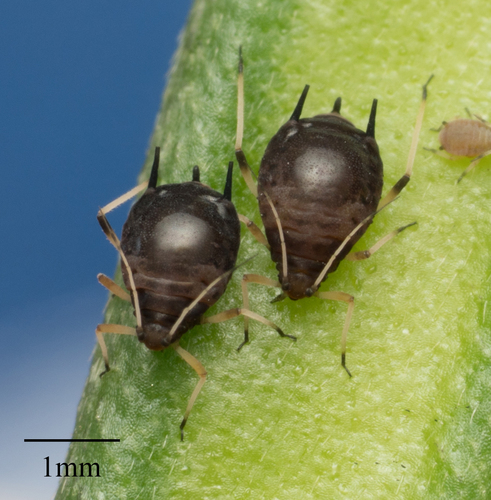
Cowpea Aphid
Aphis craccivora
The Cowpea Aphid is a tiny marvel of the insect world, identifiable by its polished black armor and its remarkable ability to form massive colonies almost overnight. A frequent visitor to backyard bean patches, it plays a central role in the complex dance between plants, ants, and predators.
Quick Identification
Size
1.5–2.5 mm (0.06–0.1 inches) in length
Colors
Adults are a distinctive shiny black or very dark brown; nymphs are duller and often appear lightly dusted with a greyish waxy secretion. Legs are pale yellow or white with dark tips.
Key Features
- Shiny, globose black body in adults
- Pale legs with black 'socks'
- Dense colonies found on legume stems and leaf undersides
- Two dark tail-pipes (siphunculi) at the rear
When You’ll See Them
Geographic range
Where Does the Cowpea Aphid Live?
Originally native to the Palearctic region of Europe and Northern Asia, the Cowpea Aphid has successfully expanded its territory to become a cosmopolitan species found on every continent except Antarctica. It is exceptionally widespread across the United States, Southern Canada, and Mexico, and maintains high population densities throughout the tropical and subtropical regions of Africa, Asia, and Australia. This insect thrives wherever its legume host plants are grown, from industrial farmlands to small residential window boxes.
Basemap © OpenStreetMap contributors
Behavior
Cowpea Aphids are highly gregarious insects, meaning they prefer to live in large, dense clusters. They are most frequently found on the tender new growth of plants, where they use their needle-like mouthparts to pierce the phloem and drink nutrient-rich sap. This feeding behavior often causes the host plant's leaves to curl, yellow, or become stunted. Because they consume more sugar than they can process, they excrete a sticky substance called honeydew, which often coats the leaves below the colony.
One of the most fascinating aspects of their behavior is their mutualistic relationship with ants. Ants will often 'farm' these aphids, protecting them from predators like ladybugs and lacewings in exchange for the sugary honeydew. Cowpea Aphids are also known for their incredible reproductive speed; females can produce live young without mating (parthenogenesis), allowing a single aphid to start a massive colony in just a matter of days. When a colony becomes too crowded or the host plant begins to die, the aphids will produce a generation of winged individuals (alates) that fly off to colonize new plants.
EverydayEarth exclusive
Camera Tips
Capturing the Cowpea Aphid requires a specialized approach, as standard trail cameras are usually designed for larger mammals and will not focus on something only two millimeters long. To see these insects, you need an AI-powered backyard camera with a dedicated macro lens or a high-resolution sensor that allows for extreme digital cropping. Position your camera just a few inches away from the terminal buds or the undersides of leaves on legume plants like snap peas or clover. Since these aphids don't move much once they start feeding, they are excellent subjects for high-detail macro photography.
For the best results, look for the 'sentinel' signs of an aphid colony: curling leaves or the presence of ants running up and down a stem. Setting your camera to a time-lapse mode can reveal the hidden dynamics of the colony, showing how they shift positions and how ants interact with them. If your camera has adjustable lighting or a flash, use it to highlight the glossy, metallic-like sheen of the adult aphids' black bodies, which can otherwise look like a flat black blob in natural shade.
Pay close attention to the background and lighting. Because Cowpea Aphids are dark, they look best when photographed against the vibrant green of a healthy leaf with side-lighting to define their shape. If you are using a camera with AI triggers, you may need to manually trigger the capture or use a motion sensor set to its highest sensitivity, as the tiny movements of aphids are rarely enough to wake a standard sensor. The most dramatic footage often occurs in the early morning when the aphids are most active and the light is soft, or during the late summer when you might catch the rare 'winged' versions of the aphids preparing to take flight.
Similar Species
Species that look similar or are commonly confused with Cowpea Aphid.
Black Bean Aphid
Has a dull, matte black body compared to the Cowpea Aphid's high-gloss, shiny exoskeleton.
Pea Aphid
Much larger than the Cowpea Aphid and usually bright green in color, though pink variants exist.
Melon Aphid
Usually smaller and varies in color from pale yellow to dark green, rather than the deep black of the Cowpea Aphid.
Frequently Asked Questions
Record Cowpea Aphid at your habitat
Connect a camera to start building your own species record — AI identifies every visitor automatically.