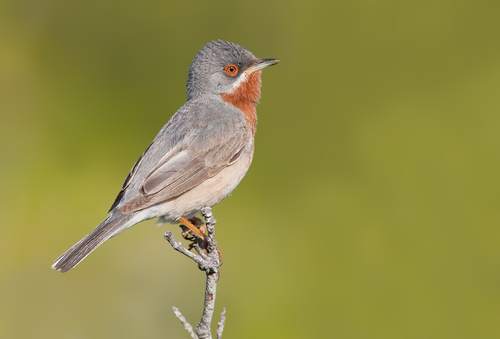
Eastern Subalpine Warbler
Curruca cantillans
A Mediterranean jewel, the Eastern Subalpine Warbler is a master of disguise in the thickets. With its striking white mustache and fiery breast, it brings a splash of color to the rugged scrublands of Southeast Europe.
Quick Identification
Size
Length: 12-13 cm (4.7-5.1 in); Wingspan: 15-19 cm (5.9-7.5 in); Weight: 9-12 g (0.3-0.4 oz)
Colors
Males feature lead-grey upperparts with a rich brick-red or cinnamon throat and breast. A conspicuous white malar 'mustache' streak separates the grey head from the red throat. Females and juveniles are much duller, with brownish-grey tones and pale sandy-pink underparts.
Key Features
- Distinctive white malar (mustache) stripe
- Brick-red throat and breast in males
- Fine white eye-ring
- Frequent tail-flicking and skulking behavior
When You’ll See Them
Geographic range
Where Does the Eastern Subalpine Warbler Live?
Native to the sun-drenched landscapes of Southeastern Europe and the Eastern Mediterranean, the Eastern Subalpine Warbler is a quintessential summer visitor to the Balkans. Its core breeding range stretches across Southern Italy, Greece, Western Turkey, and North Macedonia, extending into parts of Bulgaria and Romania. After the breeding season, these birds undertake a long-distance migration across the Mediterranean Sea and the Sahara Desert to winter in the Sahel region of Africa, spanning from Senegal to Sudan.
Basemap © OpenStreetMap contributors
Behavior
The Eastern Subalpine Warbler is a restless, high-energy insectivore that spends much of its time 'skulking' through dense scrub and low-lying vegetation. While they are often difficult to spot in the open, their presence is frequently betrayed by their sharp, metallic 'tek' call or the male's fast, rattling warble, usually delivered from the top of a bush before diving back into cover. They are highly active foragers, constantly flitting between branches to glean small invertebrates.
During the breeding season, they are territorial but generally shy around human habitation unless gardens offer the dense, 'wild' Mediterranean-style thickets they prefer. Unlike some bolder garden birds, they rarely visit traditional bird feeders, instead relying on natural foraging opportunities. As a migratory species, they exhibit strong seasonal movements, arriving in their European breeding grounds in early spring and departing for sub-Saharan Africa in late summer.
EverydayEarth exclusive
Camera Tips
Capturing the Eastern Subalpine Warbler on camera requires strategic placement because they rarely venture into open spaces. Position your camera at a low height—roughly 0.5 to 1.5 meters off the ground—aimed directly into the heart of dense, twiggy shrubs or brambles. These birds love 'edges' where thick cover meets a small clearing, so aim your lens at a transition zone rather than a wide-open lawn.
Because they don't typically use seed feeders, the best way to lure them into the frame is with a shallow, moving water feature. A small solar-powered dripper or a birdbath with stones for perching is irresistible to these warblers, especially during the heat of a Mediterranean afternoon. Ensure the camera is set to a fast shutter speed or high-frame-rate video mode, as their movements are incredibly erratic and quick.
Settings-wise, use a 'High' sensitivity trigger for your PIR sensor because of the bird's small size and rapid movement. If your camera supports AI-subject detection, ensure it is set to 'Small Birds' to avoid missing the quick 'hop-and-hide' behavior they exhibit. Early morning light is best for capturing the subtle brick-red tones of the male's breast, as midday sun can wash out their colors against the bright scrubland background.
Similar Species
Species that look similar or are commonly confused with Eastern Subalpine Warbler.
Western Subalpine Warbler
Very similar, but males have a paler orange-pink throat that does not extend as far down the belly as the Eastern species.
Moltoni's Warbler
Visually almost identical but has a salmon-pink breast and a completely different rattling call.
Dartford Warbler
Darker overall with a much longer tail and a darker wine-red breast without the white mustache streak.
Frequently Asked Questions
Record Eastern Subalpine Warbler at your habitat
Connect a camera to start building your own species record — AI identifies every visitor automatically.