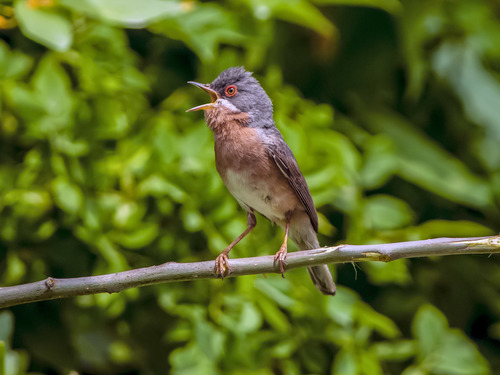
Moltoni's Warbler
Curruca subalpina
A hidden gem of the Mediterranean thickets, Moltoni's Warbler is a master of stealth and song. With its delicate salmon-pink breast and energetic personality, this migratory marvel is a highlight for any backyard observer in Southern Europe.
Quick Identification
Size
Length: 12–13 cm (4.7–5.1 in); wingspan: 15–19 cm (6–7.5 in); weight: 9–11 g (0.3–0.4 oz)
Colors
Males have blue-grey upperparts and salmon-pink to pale terracotta underparts with a white moustachial stripe. Females are sandy-brown above with buff-white underparts.
Key Features
- Salmon-pink underparts in males
- Distinctive white moustachial stripe
- Reddish-orange eye ring
- Jerky, restless tail movements
- Unique 'rattle' call unlike other subalpine warblers
When You’ll See Them
Geographic range
Where Does the Moltoni's Warbler Live?
Moltoni's Warbler is a Mediterranean specialist, with its primary breeding grounds located in northern and central Italy, as well as the islands of Corsica, Sardinia, and the Balearics. This species is a long-distance migrant, traveling south each autumn to winter in the arid Sahel region of Africa, stretching from Senegal to Chad. While they are occasionally recorded as vagrants in northern Europe, they are most reliably found in the sun-drenched, scrub-covered hillsides of their native Italian and island ranges.
Basemap © OpenStreetMap contributors
Behavior
These birds are highly migratory, navigating between the Mediterranean and the sub-Saharan Sahel twice a year. Their movements are characterized by quick, nervous hops and frequent tail-flicking. While they are generally solitary during the breeding months, they can occasionally be seen in loose associations with other warblers during migration, though they remain fiercely protective of their immediate nesting sites.
EverydayEarth exclusive
Camera Tips
Capturing a high-quality image of Moltoni's Warbler requires patience and an understanding of their love for 'edge' habitats. These birds rarely venture far from dense cover, so place your camera where thick shrubbery meets a path or a small opening. A mounting height of about 0.5 to 1 metre is ideal, as they spend most of their time foraging in the lower to middle strata of bushes. Because they are fast-moving, ensure your camera is set to a fast shutter speed or a rapid-fire burst mode to catch their quick movements.
Water is the most effective way to attract this species to a camera trap, especially in the dry Mediterranean climate. A shallow, natural-looking birdbath placed near thick brush will often entice them out of hiding for a drink or a bath. Position the camera about 1.5 to 2 metres from the water source and use a focal length or setting that allows for a clear macro-style shot. Ensure there is no moving vegetation in the immediate foreground, as the PIR sensors on many cameras will trigger constantly in the coastal breeze.
During the spring (April and May), look for 'singing posts'—typically the highest branch of a prominent bush like Juniper or Holm Oak. Males will return to these spots repeatedly to sing. If you can identify such a perch, aim your camera there with a slightly upward angle. Since Moltoni's Warbler is notoriously similar to the Western Subalpine Warbler, try to capture the bird's profile; the specific salmon-pink hue of the throat and chest is the most reliable way to identify them from photos.
Similar Species
Species that look similar or are commonly confused with Moltoni's Warbler.
Western Subalpine Warbler
Deep brick-red underparts and a distinct 'tak' call, whereas Moltoni's is salmon-pink with a rattling call.
Eastern Subalpine Warbler
The male has more restricted red on the throat and a different, harder call note.
Sardinian Warbler
Larger with a distinctive jet-black cap (in males) and a bright red fleshy eye-ring, lacking the pinkish underparts.
Frequently Asked Questions
Record Moltoni's Warbler at your habitat
Connect a camera to start building your own species record — AI identifies every visitor automatically.