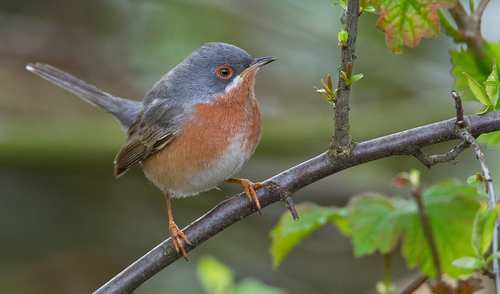
Western Subalpine Warbler
Curruca iberiae
A vibrant jewel of the Mediterranean thickets, the Western Subalpine Warbler is famous for its striking terracotta breast and energetic personality. This tiny migrant is a favorite for backyard birders across Southern Europe.
Quick Identification
Size
Length of 12-13 cm (4.7-5.1 inches); wingspan of 15-19 cm (5.9-7.5 inches); weight of 9-12 grams (0.3-0.4 ounces).
Colors
Males have blue-grey upperparts, a deep terracotta-red throat and breast, and a prominent white moustachial stripe. Females are duller with grey-brown backs and pale pinkish-buff underparts.
Key Features
- Distinctive white 'moustache' stripe
- Terracotta-orange throat and breast (males)
- White eye-ring
- Frequent tail-cocking behavior
- Blue-grey upperparts
When You’ll See Them
Geographic range
Where Does the Western Subalpine Warbler Live?
Native to the Mediterranean region, the Western Subalpine Warbler primarily breeds in the Iberian Peninsula, southern France, and northwest Africa, including Morocco and Tunisia. After the breeding season, these birds migrate south across the Sahara Desert to spend the winter in the dry savannas of the African Sahel. While they are southern specialists, they are occasionally spotted further north in Europe as rare spring vagrants.
Basemap © OpenStreetMap contributors
Behavior
The Western Subalpine Warbler is a restless and energetic songbird, typical of the Mediterranean scrub it calls home. It is a master of movement, constantly flitting through dense foliage and thickets in search of prey. While it can be secretive and difficult to spot within deep cover, males are known to emerge in the spring to sing their fast, rattling songs from the tops of bushes or during brief song-flights.
These birds are highly territorial during the breeding season but maintain a shy demeanor around humans. They are characterized by a nervous habit of flicking their wings and cocking their tails as they hop between branches. As long-distance migrants, they spend their lives in a cycle of high-energy movement, crossing the Sahara twice a year between their breeding and wintering grounds.
EverydayEarth exclusive
Camera Tips
To catch the Western Subalpine Warbler on camera, you need to focus on 'edge' habitats. These birds love the interface between dense bushes and open patches. Place your camera at a height of 3 to 4 feet, aiming at a clear perch within a thicket or near a flowering shrub that attracts small insects. Because they move so quickly, use a fast shutter speed or a high-frame-rate video setting to avoid motion blur.
Water is the absolute best lure for this species. A shallow, dripping birdbath or a misting feature in a garden can draw them out of hiding. Position your camera at water level about 3 to 5 feet away from the bath. If your camera allows for pre-trigger recording, enable it, as these birds often land and depart in the blink of an eye. They are wary of new objects, so use a camouflage wrap on your camera and leave it in place for a few days before expecting results.
The best time for filming is during the spring migration (April and May) when males are in their brightest plumage and most active. In the late summer, aim your camera at shrubs with small berries like wild currants or blackberries. Since they are small, ensure your camera's focal distance is set correctly for close-up shots; otherwise, you might end up with a blurry bird and a sharp background.
Similar Species
Species that look similar or are commonly confused with Western Subalpine Warbler.
Eastern Subalpine Warbler
Very similar, but males have a more restricted red area on the throat and a cleaner white belly, with a distinct 'tek-tek' call.
Moltoni's Warbler
Features a paler, salmon-pink breast rather than terracotta, and has a very different rattling trill call.
Common Whitethroat
Lacks the terracotta breast and blue-grey back; has a more uniform brownish back and a much whiter throat.
Frequently Asked Questions
Record Western Subalpine Warbler at your habitat
Connect a camera to start building your own species record — AI identifies every visitor automatically.