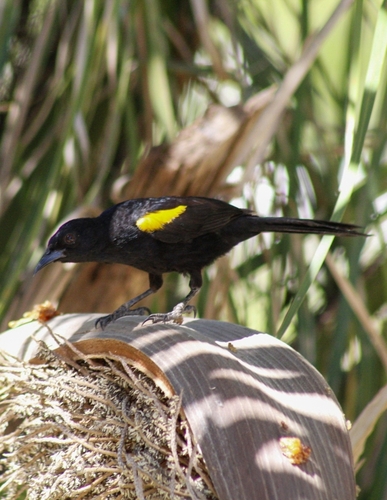
Epaulet Oriole
Icterus cayanensis
With its sleek jet-black plumage and brilliant golden shoulders, the Epaulet Oriole is a master of contrast in the South American canopy. This agile songbird is a delight for backyard observers, often visiting gardens for a taste of nectar or fruit.
Quick Identification
Size
Length: 19–21 cm (7.5–8.3 in); Weight: 30–35 g (1.1–1.2 oz)
Colors
Glossy jet-black body with vibrant yellow or golden-orange shoulder patches (epaulets); both sexes look similar.
Key Features
- Slender, slightly decurved black bill
- Glossy all-black plumage
- Bright yellow or golden-orange shoulder patches
- Long, rounded tail
- Slim, agile body shape
When You’ll See Them
Geographic range
Where Does the Epaulet Oriole Live?
The Epaulet Oriole is a native resident of South America, primarily inhabiting the northern and central regions of the continent. Its core range encompasses the massive Amazon Basin, extending through Brazil, the Guianas, Suriname, and into southern Venezuela and eastern Colombia. It is also commonly found in the tropical lowlands of eastern Peru and northern Bolivia, where it thrives in humid environments near water sources. While primarily a lowland species, it can occasionally be found in the foothills of the Andes where suitable forest edge habitat exists.
Basemap © OpenStreetMap contributors
Behavior
While they are not as loud as some other oriole species, they possess a pleasant, melodic song consisting of varied whistles and chattering notes. They are generally shy around humans but can become accustomed to backyard environments that provide plenty of cover and native flowering plants. Their social behavior is relatively peaceful, though they will defend their immediate nesting territory from other medium-sized birds.
EverydayEarth exclusive
Camera Tips
Setting your camera to a fast trigger speed is essential, as these orioles are quick and rarely stay still for long. Use a burst mode of 3-5 photos to ensure you catch the moment they spread their wings, which is when the striking yellow epaulets are most visible. If your camera supports it, recording in 4K video at 30 or 60 fps will help capture the subtle iridescent sheen of their black feathers and their fluid movements.
For baiting, try using sliced oranges or specialized nectar feeders filled with a simple sugar-water mix (no red dye needed). In more natural settings, focus your camera on flowering 'Moriche' palms if available, as they are a preferred food source. Early morning light is your best friend; it provides the necessary illumination to distinguish the bird's black plumage from dark foliage without the harsh shadows of the midday sun. Check your camera's PIR sensitivity and set it to high, as these birds are relatively lightweight and may not trigger low-sensitivity sensors from a distance.
Similar Species
Species that look similar or are commonly confused with Epaulet Oriole.
Variable Oriole
Found further south in Argentina and Paraguay, and often features darker, tawny-colored shoulder patches rather than bright yellow.
Yellow-shouldered Blackbird
Geographically isolated to Puerto Rico; it has a thicker bill and different vocalizations.
Golden-winged Cacique
Larger bird with a distinct crest and much more extensive yellow on its wings and tail.
Frequently Asked Questions
Record Epaulet Oriole at your habitat
Connect a camera to start building your own species record — AI identifies every visitor automatically.