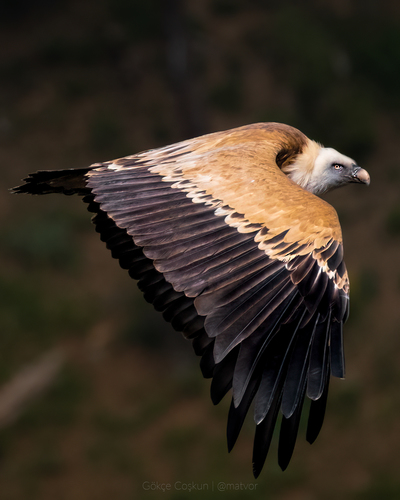
Eurasian Griffon
Gyps fulvus
The Eurasian Griffon is a majestic master of the mountain thermals, boasting a wingspan that can reach nearly nine feet. These essential scavengers serve as nature's clean-up crew, soaring with prehistoric grace over the rugged landscapes of the Old World.
Quick Identification
Size
Length: 93-122 cm (37-48 in); Wingspan: 2.3-2.8 m (7.5-9.2 ft); Weight: 6-11 kg (13-24 lb)
Colors
Creamy-buff to sandy-brown body with dark brown flight feathers; white downy ruff at the base of the neck; pale-skinned head and neck
Key Features
- Massive wingspan with deeply slotted 'fingered' primaries
- Distinctive white neck ruff (adults) or brown ruff (juveniles)
- Short, dark, squared-off tail
- Strong, pale yellowish hooked bill
When You’ll See Them
Geographic range
Where Does the Eurasian Griffon Live?
The Eurasian Griffon occupies a sprawling range across the Old World, stretching from the rugged mountain chains of the Iberian Peninsula and North Africa through the Mediterranean basin into the Middle East and the Himalayas. While Spain hosts the largest and most stable population in Europe, successful conservation efforts have reintroduced the species to parts of France, Italy, and the Balkans. These birds are most at home in wide-open, sun-drenched landscapes where thermal air currents provide the lift necessary for their long-distance foraging flights.
Basemap © OpenStreetMap contributors
Behavior
The Eurasian Griffon is a highly gregarious scavenger that relies on social intelligence to survive. During the day, they are masters of the air, utilizing their massive wings to soar on rising thermals with minimal effort. They often forage in loose groups, watching both the ground and each other; when one vulture descends toward a potential meal, others miles away notice the change in flight pattern and follow, leading to large communal gatherings at carcasses.
While they are formidable in size, they are remarkably peaceful birds, lacking the powerful talons of eagles. Their social structure is most evident at breeding colonies located on inaccessible cliff ledges, where pairs bond for life and raise a single chick annually. In these colonies and at feeding sites, they communicate through a series of guttural grunts, hisses, and cackling sounds that can be surprisingly loud despite their lack of a true syrinx.
EverydayEarth exclusive
Camera Tips
Capturing a Eurasian Griffon on camera is a thrilling challenge because of their massive scale and preference for remote heights. If you are in a rural or mountainous area, place your camera in an open clearing that offers a wide field of view. These vultures need significant 'runway' space to land and take off, so they avoid tight, enclosed spaces. Position the camera on a low rock or a sturdy fence post at a height of about 2 to 3 feet, angled slightly upward to catch them as they descend or socialise on the ground.
Timing is everything with this species. Because they rely on thermal lift to travel, they are almost never active in the early morning or late evening. Set your AI-powered camera to its most active mode between 10:00 AM and 4:00 PM. If your camera supports high-speed triggers, use them; even though they are large, their movements during a feeding squabble can be lightning-fast, and a slow shutter will result in a blur of feathers. Video mode is particularly rewarding with Griffons, as it captures their unique social huffing and the impressive sound of their wings cutting the air.
In many regions, 'vulture restaurants'—designated spots where safe carrion is provided—are the best places to set up a trail camera. If you are monitoring such a site, place the camera at least 10-15 meters away from the carcass. Griffons are wary and have excellent eyesight; they will spot a poorly hidden or 'new' object quickly. Leave the camera in place for several days before expecting results, allowing the birds to become accustomed to its presence. Avoid using infrared flash at night, as it isn't needed for this diurnal bird and may attract unwanted nocturnal scavengers that could disturb your setup.
Similar Species
Species that look similar or are commonly confused with Eurasian Griffon.
Cinereous Vulture
Much darker, almost uniform dark brown/black plumage and a heavier, darker head and beak.
Bearded Vulture
Features a diamond-shaped tail and long, narrow wings, unlike the broad wings and square tail of the Griffon.
Egyptian Vulture
Significantly smaller with a bright yellow face and white plumage with black wingtips.
Frequently Asked Questions
Record Eurasian Griffon at your habitat
Connect a camera to start building your own species record — AI identifies every visitor automatically.