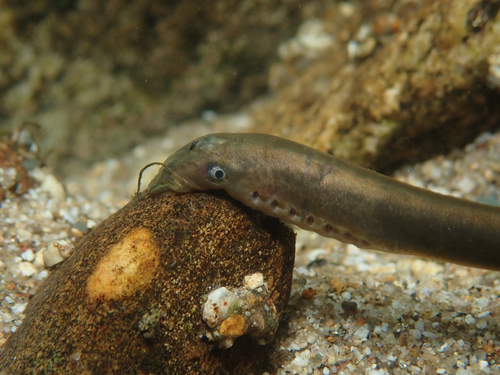
European Brook Lamprey
Lampetra planeri
A primitive survivor from the age of dinosaurs, the European Brook Lamprey is a fascinating, jawless resident of our cleanest streams. Unlike its parasitic cousins, this species spends its brief adult life focused entirely on a dramatic spring spawning dance.
Quick Identification
Size
10–16 cm (4–6.3 in) in length; weighs approximately 5–15 g (0.2–0.5 oz)
Colors
Dark olive-green or brownish-grey on the back and sides, transitioning to a pale yellowish or silvery-white belly
Key Features
- Jawless, circular sucking disc instead of a mouth
- Seven external gill pores arranged in a line behind the eye
- Two dorsal fins that are closely joined or touching
- Primitive, eel-like body with no scales
When You’ll See Them
Geographic range
Where Does the European Brook Lamprey Live?
Native to the European continent, the European Brook Lamprey is widely distributed from the British Isles and Scandinavia in the north, stretching down through Western Europe to the Mediterranean coast. It is a common resident in the clean, upland streams of the United Kingdom, France, and Germany, as well as parts of Eastern Europe. Though widespread, its range is increasingly fragmented by industrial pollution and physical barriers like dams that prevent local movement between spawning grounds.
Basemap © OpenStreetMap contributors
Behavior
The European Brook Lamprey leads a life of two distinct phases. For the majority of its life—up to five years—it exists as a blind, worm-like larva known as an ammocoete. During this stage, it remains buried in the silt and sandy bottoms of clean streams, quietly filter-feeding and playing a vital role in the ecosystem by processing organic matter. It is rarely seen by humans during this secretive period.
Metamorphosis into the adult form occurs in autumn, bringing dramatic changes including the development of eyes and a more defined dorsal fin. Interestingly, adults do not feed at all; their digestive systems actually degenerate. They spend the winter months hiding in the substrate before emerging in spring for a frantic, communal spawning event. After building nests and laying eggs in gravelly riffles, the adults die, providing a final nutrient boost to their home stream.
EverydayEarth exclusive
Camera Tips
Capturing the European Brook Lamprey on camera requires a specialized approach since they are entirely aquatic and often hidden. The best time to attempt filming is during their spring spawning season (typically March to June, depending on water temperature). Look for "riffles"—shallow, fast-flowing sections of streams with a gravelly bottom. During this time, lampreys gather in groups to move stones and create nests, making them much easier to spot than when they are buried in silt.
Use an action camera with a high-quality waterproof housing or a dedicated underwater trail camera. Position the camera at the edge of a gravel bed, angled slightly downward to capture the stream floor. Because the water is shallow and often clear in these areas, natural light is usually sufficient during the day. Ensure the camera is securely weighted or tethered to a fixed object on the bank to prevent it from being swept away by the current or dislodged by curious wildlife.
Since these fish are not attracted to traditional bait (adults don't eat!), placement is everything. Look for the physical signs of a nest—a slight depression in the gravel where the stones look "cleaner" than the surrounding area. Setting your camera to record high-frame-rate video (60fps or higher) is highly recommended, as their spawning movements are rapid and wriggly. If your camera has a "motion trigger," be aware that flowing water and floating debris may cause false triggers; a time-lapse mode set to capture an image every 5-10 seconds during daylight hours is often more effective for monitoring a specific nesting site.
Similar Species
Species that look similar or are commonly confused with European Brook Lamprey.
Frequently Asked Questions
Record European Brook Lamprey at your habitat
Connect a camera to start building your own species record — AI identifies every visitor automatically.