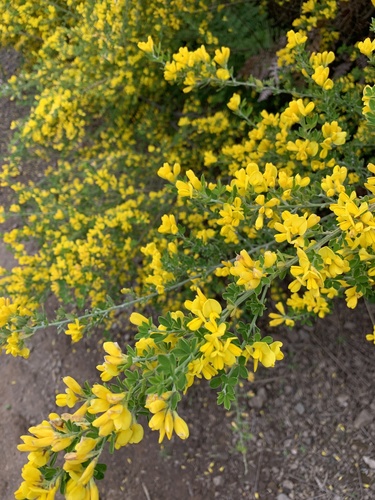
French broom
Genista monspessulana
A golden-flowered invader from the Mediterranean, French broom is a master of rapid expansion, transforming backyards and wildlands with its dense, fire-prone thickets.
Quick Identification
Size
1–3 meters (3–10 feet) tall; spread up to 2 meters (6.5 feet)
Colors
Bright yellow flowers; medium-green foliage; dark brown to black seed pods
Key Features
- Clusters of 3-9 yellow pea-like flowers
- Small leaves divided into three rounded leaflets
- Dense, upright green stems with subtle ridges
- Fuzzy, flat seed pods about 1 inch long
When You’ll See Them
Geographic range
Where Does the French broom Live?
Native to the Mediterranean region of Southern Europe and North Africa, French broom has become a widespread invasive species across several continents. It is most prominently established along the West Coast of North America, particularly in California, Oregon, and Washington, as well as throughout parts of Australia and New Zealand. The species thrives in Mediterranean-style climates but has adapted to various temperate zones globally.
Basemap © OpenStreetMap contributors
Behavior
French broom is a highly competitive and aggressive perennial shrub known for its ability to dominate landscapes quickly. As a nitrogen-fixing legume, it alters soil chemistry to suit its own needs, often making the environment less hospitable for native plant species. Its primary 'behavior' is its rapid reproductive cycle; a single mature plant can produce upwards of 8,000 seeds per year, which can remain viable in the soil for decades.
Interaction with the environment is most notable during its flowering season when it provides a massive nectar source for bees, though this often draws pollinators away from native flora. For humans, the plant represents a significant fire hazard. It contains high amounts of volatile oils and grows in dense thickets that act as 'ladder fuels,' allowing ground fires to climb easily into the forest canopy. Because of its invasive nature, it is classified as a noxious weed in many regions.
EverydayEarth exclusive
Camera Tips
When setting up an AI-powered camera to monitor French broom, focus on the plant's phenology—the timing of its biological stages. Place your camera on a sturdy tripod or mount it to a nearby fence post at a height of about 3 to 4 feet. This mid-level positioning allows you to capture the full structure of the bush and the density of its yellow blooms. Because the plant is stationary, use a wide-angle lens setting to document how it spreads and interacts with the surrounding vegetation over time.
Lighting is crucial for capturing the vibrant yellow of the flowers. Aim your camera toward the east or west to take advantage of the 'golden hour' light, which prevents the bright yellow petals from appearing washed out or overexposed in your photos. If you are using motion-trigger settings, be aware that the plant's flexible stems will move significantly in the wind, which can lead to thousands of empty triggers. Adjust your camera's sensitivity to a lower setting or use a time-lapse mode—one photo every 30 minutes—to capture the daily opening of flowers and visiting pollinators without draining your battery.
To document the plant's invasive strategy, point your camera toward the ground beneath the shrub during the late summer. As the seed pods dry and turn dark brown, they undergo explosive dehiscence, physically launching seeds several feet away. A high-speed video setting (if available) can occasionally catch these pods snapping open on hot, dry afternoons. Monitoring these seed pods is essential for land management, helping you identify exactly when the plant is most likely to spread further into your yard.
Finally, use your camera to observe the 'community' that forms around the broom. While the plant itself is the subject, the AI will likely trigger on the many insects, such as honeybees and bumblebees, that frequent the flowers. This data is incredibly valuable for understanding how invasive species integrate into local ecosystems. Keep the lens clear of the sticky residue sometimes produced by aphids that inhabit the broom's tender new growth, as this can blur your shots over time.
Similar Species
Species that look similar or are commonly confused with French broom.
Scotch Broom
Scotch broom has larger, usually solitary flowers and five-angled, darker green stems that appear almost leafless.
Spanish Broom
Features thick, round, rush-like stems that are almost entirely devoid of leaves and much larger, fragrant flowers.
Gorse
Easily distinguished by its sharp, stiff spines (modified leaves) that make the plant painful to touch.
Frequently Asked Questions
Record French broom at your habitat
Connect a camera to start building your own species record — AI identifies every visitor automatically.